

NSE4_FGT_AD-7.6 Free Study Guide! with New Update 96 Exam Questions
Get up-to-date Real Exam Questions for NSE4_FGT_AD-7.6 UPDATED [2026]
NEW QUESTION # 31
Refer to the exhibits.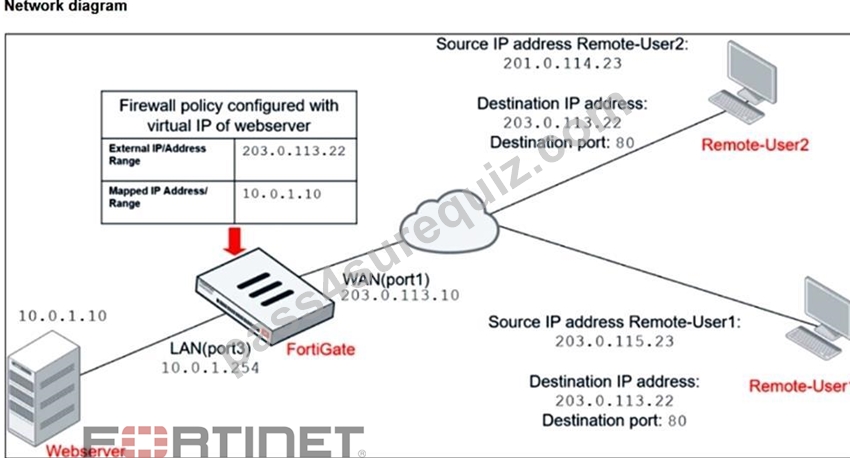
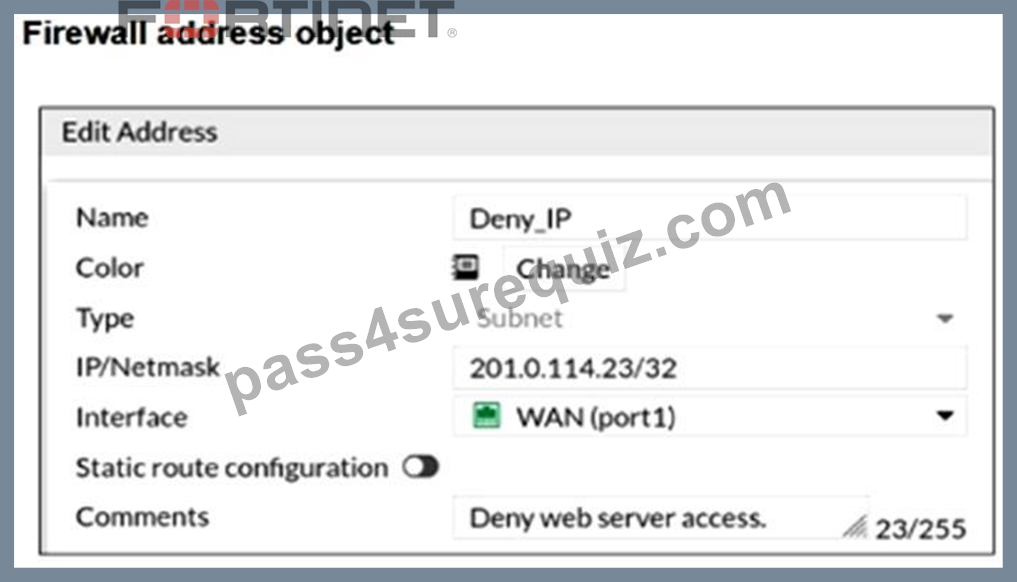
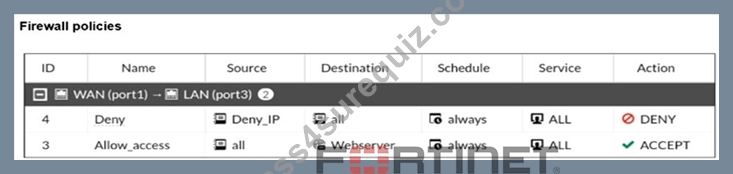
The exhibits show a diagram of a FortiGate device connected to the network, and the firewall configuration.
An administrator created a Deny policy with default settings to deny Webserver access for Remote-User2.
The policy should work such that Remote-User1 must be able to access the Webserver while preventing Remote-User2 from accessing the Webserver.
Which two configuration changes can the administrator make to the policy to deny Webserver access for Remote-User2? (Choose two.)
- A. Disable match-vipin the Deny policy.
- B. Set the Destination address as Webserver in the Deny policy.
- C. Set the Destination address as Deny_IP in the Allow_access policy.
- D. Enable match-vipin the Deny policy.
Answer: B,D
Explanation:
In this scenario, the FortiGate uses a Virtual IP (VIP) to map the external IP 203.0.113.22 to the internal web server 10.0.1.10. When using VIPs, firewall policies must be configured carefully to match the translated destination address.
The external users (Remote-User1 and Remote-User2) connect to 203.0.113.22, which is the VIP for the web server.
By default, firewall policies match pre-NAT addresses (the original destination before VIP translation).
To make the deny policy recognize traffic destined for the VIP-mapped address, the match-vip option must be enabled.
The destination in the Deny policy should explicitly be the Webserver (the VIP object), so FortiGate correctly identifies the target.
NEW QUESTION # 32
Refer to the exhibits.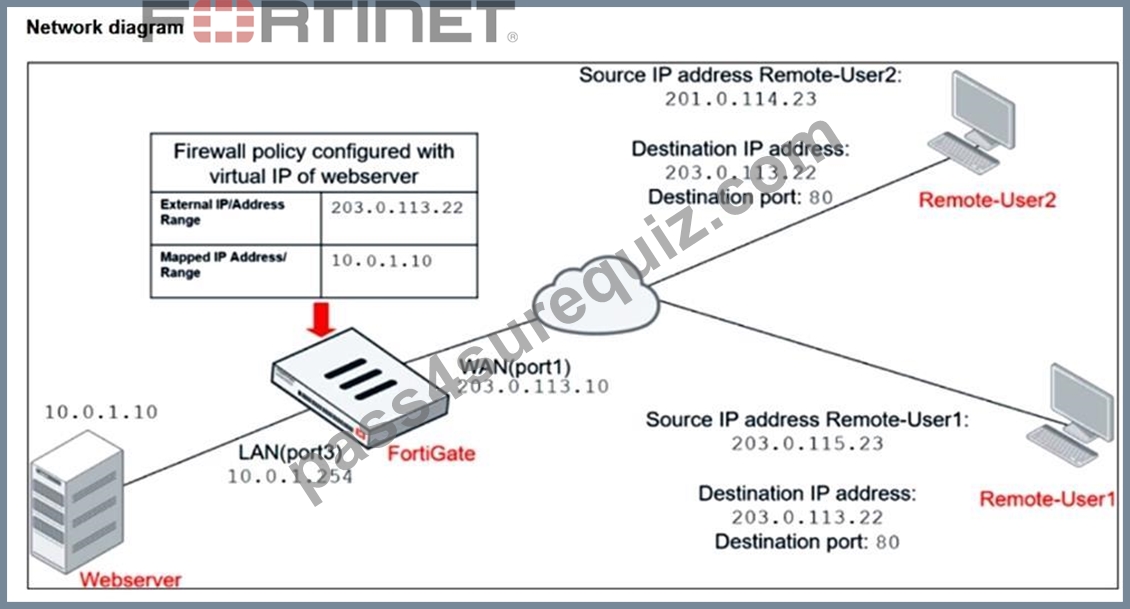
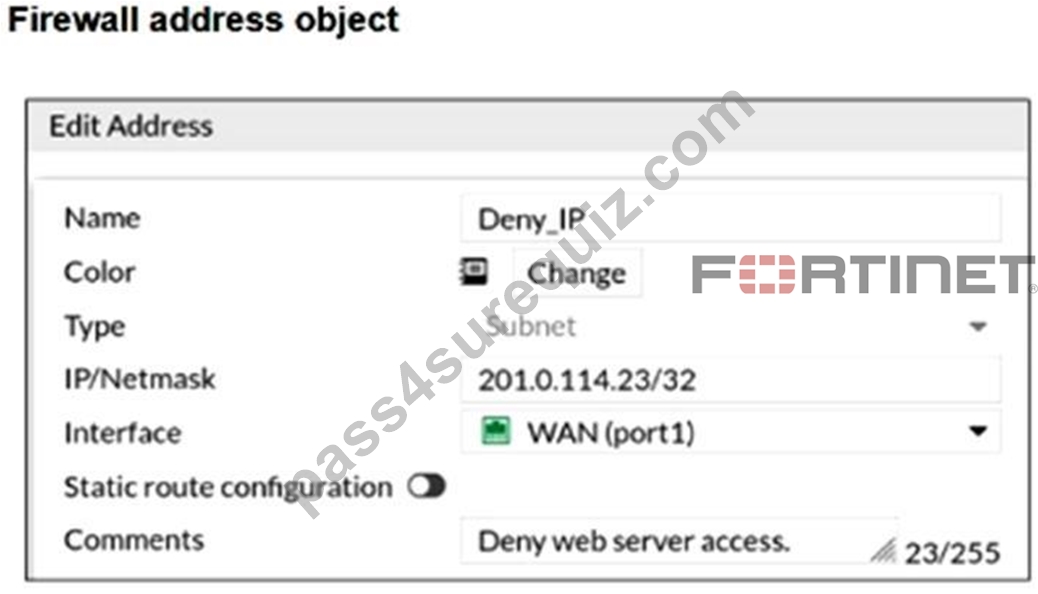
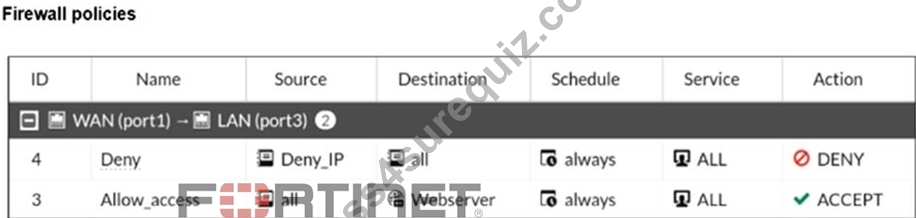
The exhibits show a diagram of a FortiGate device connected to the network, and the firewall configuration.
An administrator created a Deny policy with default settings to deny Webserver access for Remote-User2.
The policy should work such that Remote-User1 must be able to access the Webserver while preventing Remote-User2 from accessing the Webserver.
Which two configuration changes can the administrator make to the policy to deny Webserver access for Remote-User2? (Choose two.)
- A. Disable match-vipin the Deny policy.
- B. Set the Destination address as Webserver in the Deny policy.
- C. Set the Destination address as Deny_IP in the Allow_access policy.
- D. Enable match-vipin the Deny policy.
Answer: B,D
Explanation:
In this scenario, the FortiGate uses a Virtual IP (VIP) to map the external IP 203.0.113.22 to the internal web server 10.0.1.10. When using VIPs, firewall policies must be configured carefully to match the translated destination address.
The external users (Remote-User1 and Remote-User2) connect to 203.0.113.22, which is the VIP for the web server.
By default, firewall policies match pre-NAT addresses (the original destination before VIP translation).
To make the deny policy recognize traffic destined for the VIP-mapped address, the match-vip option must be enabled.
The destination in the Deny policy should explicitly be the Webserver (the VIP object), so FortiGate correctly identifies the target.
NEW QUESTION # 33
Refer to the exhibit.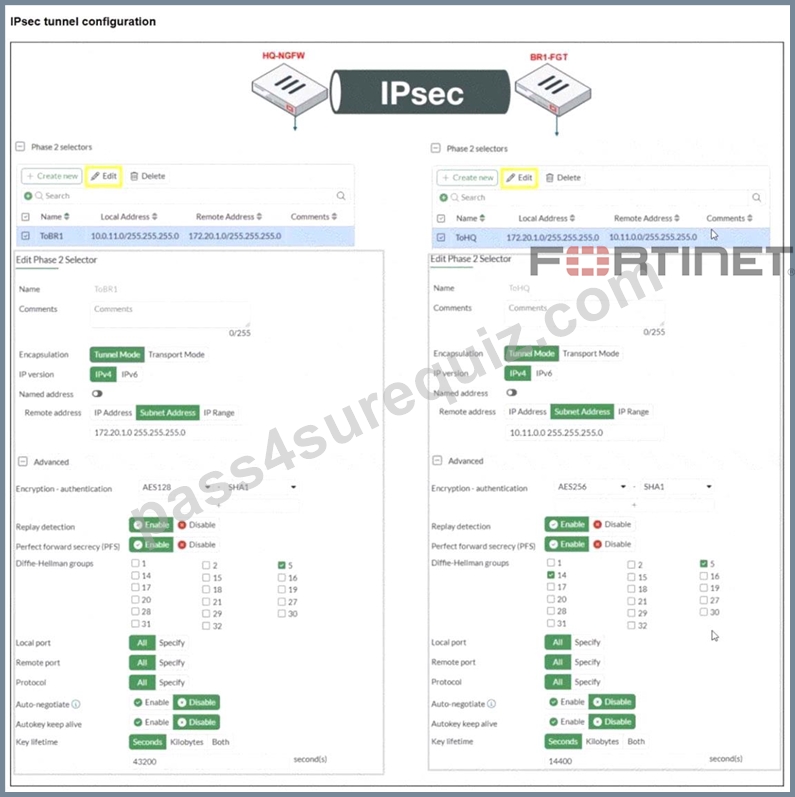
A network administrator is troubleshooting an IPsec tunnel between two FortiGate devices. The administrator has determined that phase 1 status is up, but phase 2 fails to come up.
Based on the phase 2 configuration shown in the exhibit, which two configuration changes will bring phase 2 up? (Choose two.)
- A. On BR1-FGT, set Remote Address to 10.0.11.0/255.255.255.0.
- B. On HQ-NGFW. enable Diffie-Hellman Group 2.
- C. On HQ-NGFW. set Encryption to AES256.
- D. On BR1-FGT. set Seconds to 43200
Answer: A,C
Explanation:
Phase 1 being up confirms the two FortiGate devices can authenticate and build the IKE SA. Phase 2 failing indicates the IPsec (Quick Mode) SA negotiation is failing due to mismatched Phase 2 parameters.
From the exhibit, the Phase 2 mismatches that would prevent SA establishment are:
1) Phase 2 selectors must mirror each other (Proxy IDs)
HQ-NGFW Phase 2 selector shows:
Local: 10.0.11.0/24
Remote: 172.20.1.0/24
BR1-FGT Phase 2 selector shows:
Local: 172.20.1.0/24
Remote: 10.11.0.0/24 # does not match HQ's local subnet (10.0.11.0/24)
In FortiOS, Phase 2 comes up only when the peers' selectors (proxy IDs) match as opposite pairs (local on one side = remote on the other).
# Fix: A. On BR1-FGT, set Remote Address to 10.0.11.0/255.255.255.0.
2) Phase 2 proposal must match (encryption/authentication)
HQ-NGFW shows encryption AES128 (with SHA1)
BR1-FGT shows encryption AES256 (with SHA1)
For Phase 2 to establish, both peers must have at least one common proposal (same encryption and authentication settings). With one side set to AES128 and the other to AES256, there is no match.
# Fix: D. On HQ-NGFW, set Encryption to AES256.
Why the other options are not correct
B). Enable Diffie-Hellman Group 2: The exhibit's mismatch is not resolved by adding DH group 2, and DH group must match when PFS is enabled. This option does not align the peers based on what's shown.
C). Set Seconds to 43200: Phase 2 lifetime mismatches typically do not prevent Phase 2 from coming up (the negotiated lifetime can be adjusted by the peers). The hard blockers here are the selectors and proposal mismatch.
NEW QUESTION # 34
A network administrator is reviewing firewall policies in both Interface Pair View and By Sequence View.
The policies appear in a different order in each view. Why is the policy order different in these two views?
- A. Interface Pair View sorts policies based on matching interfaces, while By Sequence View shows the actual processing order of rules.
- B. Policies in Interface Pair View are prioritized by security levels, while By Sequence View strictly follows the administrator ' s manual ordering.
- C. The firewall dynamically reorders policies in Interface Pair View based on recent traffic patterns, but By Sequence View remains static.
- D. By Sequence View groups policies based on rule priority, while Interface Pair View always follows the order of traffic logs.
Answer: A
NEW QUESTION # 35
Refer to the exhibit. Why is the Antivirus scan switch grayed out when you are creating a new antivirus profile for FTP?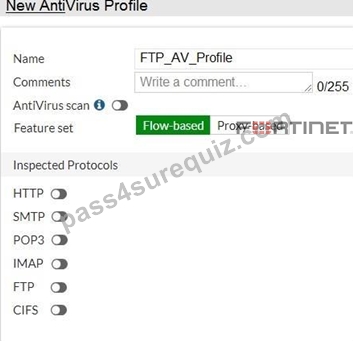
- A. Antivirus scan is disabled under System -> Feature visibility.
- B. None of the inspected protocols are active in this profile.
- C. The Feature Set for the profile is Flow-based but it must be Proxy-based.
- D. FortiGate, with less than 2 GB RAM, does not support the Antivirus scan feature.
Answer: B
Explanation:
Enable one or more protocols for inspection, then enable AntiVirus scan for the selected protocols with a specified action.
https://docs.fortinet.com/document/fortigate/7.6.4/administration-guide/922096/inspection-mode- feature-comparison
NEW QUESTION # 36
Refer to the exhibit showing a debug flow output.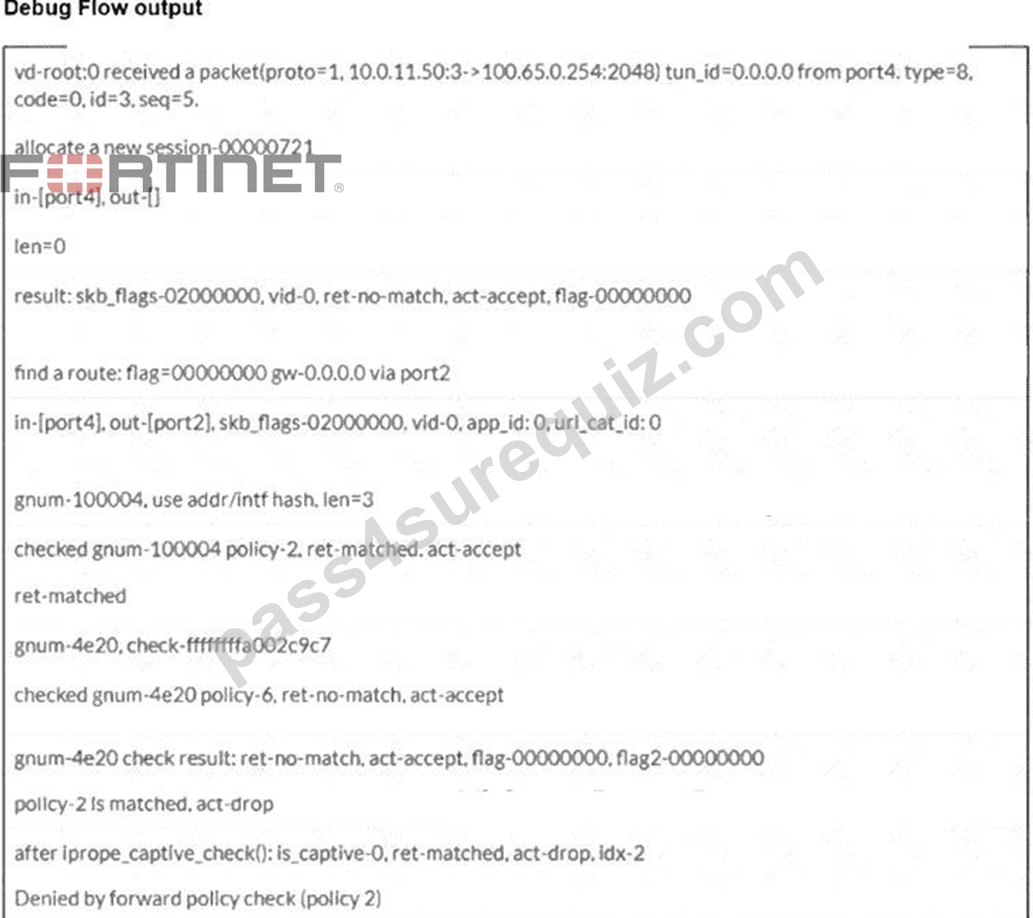
Which two conclusions can you make from the debug flow output? (Choose two answers)
- A. The debug flow is for UDP traffic.
- B. The RPF check fails.
- C. The matching firewall policy denies the traffic.
- D. The default gateway is configured on port2.
Answer: C,D
Explanation:
According to the FortiOS 7.6 Troubleshooting and Administration guides, the diagnose debug flow command provides a step-by-step trace of how the FortiGate unit processes a packet.
First, the line " find a route: flag=00000000 gw-0.0.0.0 via port2 " indicates that during the routing table lookup, the FortiGate matched the destination against its default route (represented by 0.0.0.0) and determined that the egress interface is port2 . This confirms that the default gateway for this traffic is reachable via port2 (Statement A).
Second, the debug trace concludes with the messages " policy-2 Is matched, act-drop " and " Denied by forward policy check (policy 2) " . This explicitly indicates that the packet successfully matched the criteria for firewall policy ID 2, and the action configured for that policy is set to Deny (Statement D).
Statement B is incorrect because a Reverse Path Forwarding (RPF) failure would be indicated by a specific " reverse path check fail, drop " message, which is absent here. Statement C is incorrect because the output shows " proto=1 " , which corresponds to ICMP (Ping) traffic. UDP traffic would be identified as protocol
17.
NEW QUESTION # 37
You are onboarding an agentless, secure web gateway (SWG) endpoint for secure internet access (SIA). What will happen to the user ' s nonweb traffic? (Choose one answer)
- A. The endpoint will use split tunneling to redirect nonweb traffic to FortiSASE.
- B. All the nonweb traffic will bypass FortiSASE.
- C. FortiSASE will use Firewall-as-a-Service (FWaaS) to redirect nonweb traffic.
- D. FortiSASE will use SWG to redirect nonweb traffic to FortiExtender.
Answer: B
Explanation:
"In this use case, FortiSASE acts as an SWG and distributes a proxy auto-configuration (PAC) file to end users, enabling the FortiSASE SWG service as an explicit web proxy. SWG deployment secures only web traffic protocols, such as HTTP and HTTPS."
"All other nonweb traffic bypasses FortiSASE and is forwarded directly to the internet." Technical Deep Dive:
The correct answer is A .
In agentless SWG-based SIA , FortiSASE is operating as an explicit web proxy using a PAC file . That model captures only web protocols , specifically HTTP and HTTPS . It does not create a full tunnel for the endpoint like agent-based FortiClient deployment does.
So the design implication is simple: nonweb traffic does not traverse FortiSASE in this onboarding model.
It goes directly to the internet from the endpoint.
Why the other options are wrong:
* B is wrong because this is not split-tunnel VPN behavior.
* C is wrong because FWaaS does not automatically capture nonweb traffic in the agentless SWG model.
* D is wrong because SWG does not redirect nonweb traffic to FortiExtender.
This is an important deployment distinction:
* Agent-based SIA can steer broader endpoint traffic through FortiSASE.
* Agentless SWG SIA secures only browser-based web traffic.
NEW QUESTION # 38
Refer to the exhibit. An administrator has configured an Application Overrides for the ABC.Com application signature and set the Action to Allow. This application control profile is then applied to a firewall policy that is scanning all outbound traffic. Logging is enabled in the firewall policy. To test the configuration, the administrator accessed the ABC.Com web site several times.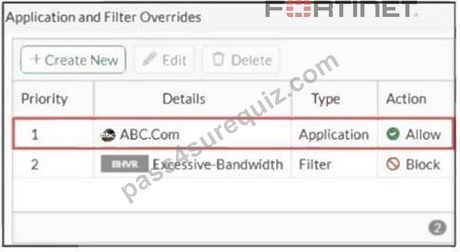
Why are there no logs generated under security logs for ABC.Com?
- A. The ABC.Com Type is set as Application instead of Filter.
- B. The ABC.Com is hitting the category Excessive-Bandwidth.
- C. The ABC.Com Action is set to Allow.
- D. The ABC.Com is configured under application profile, which must be configured as a web filter profile.
Answer: C
Explanation:
When the action is set to Allow in an application override, traffic matching this override is allowed without generating security logs because it bypasses deeper inspection and blocking.
NEW QUESTION # 39
Which two features of IPsec IKEv1 authentication are supported by FortiGate? (Choose two.)
- A. Extended authentication (XAuth) for faster authentication because fewer packets are exchanged
- B. Extended authentication (XAuth) to request the remote peer to provide a username and password
- C. No certificate is required on the remote peer when you set the certificate signature as the authentication method
- D. Pre-shared key and certificate signature as authentication methods
Answer: B,D
Explanation:
"Authentication-wise, both versions support PSK and certificate signature . Although only IKEv1 supports XAuth ..."
"Now, you will learn about the Authentication section in phase 1 configuration:
* Method: FortiGate supports two authentication methods: Pre-shared Key and Signature. When you select Pre-shared Key, you must configure both peers with the same pre-shared key. When you select Signature, phase 1 authentication is based on digital certificate signatures."
"The purpose of phase 1 is to authenticate peers and set up a secure channel... To authenticate each other, the peers use two methods: pre-shared key or digital signature . You can also enable an additional authentication method, XAuth, to enhance authentication. "
"A common use of the IPsec wizard is for configuring a remote access VPN for FortiClient users. The wizard enables IKE mode config, XAuth , and other appropriate settings for FortiClient users." Technical Deep Dive:
The correct answers are C and D .
D is correct because FortiGate supports the two primary IKEv1 authentication methods: pre-shared key and certificate signature . That is explicitly stated in the study guide.
C is also correct because FortiGate supports XAuth with IKEv1 as an additional authentication mechanism.
In practice, XAuth is used to request extra user credentials such as a username and password , especially in remote-access VPN deployments such as FortiClient.
Why the other options are incorrect:
* A is incorrect because when using Signature , certificate-based authentication is in use. The study guide states that digital signature validation depends on the relevant certificates and CA trust chain being present. It is not a certificate-free method.
* B is incorrect because "fewer packets are exchanged" is a characteristic of aggressive mode , not XAuth. XAuth enhances authentication; it is not the feature that makes IKE negotiation faster.
So the two supported IKEv1 authentication features are:
* Extended authentication (XAuth) to request the remote peer to provide a username and password
* Pre-shared key and certificate signature as authentication methods
NEW QUESTION # 40
Refer to the exhibits.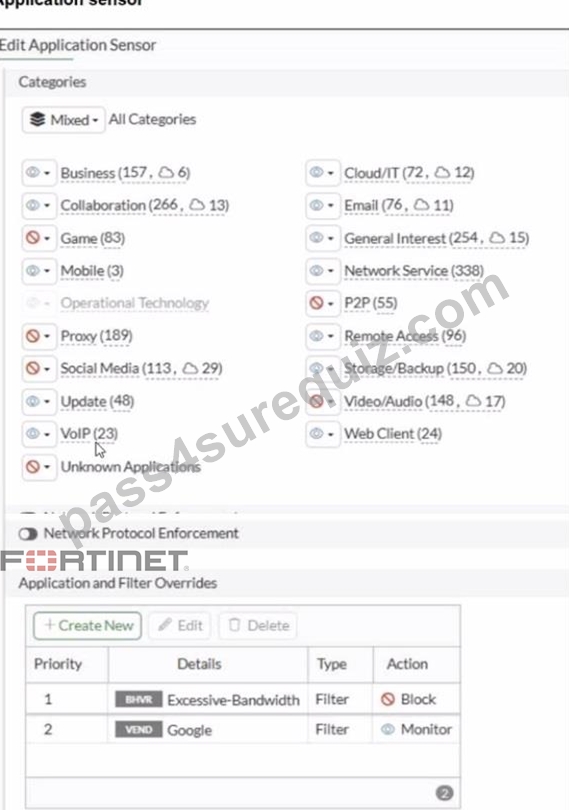
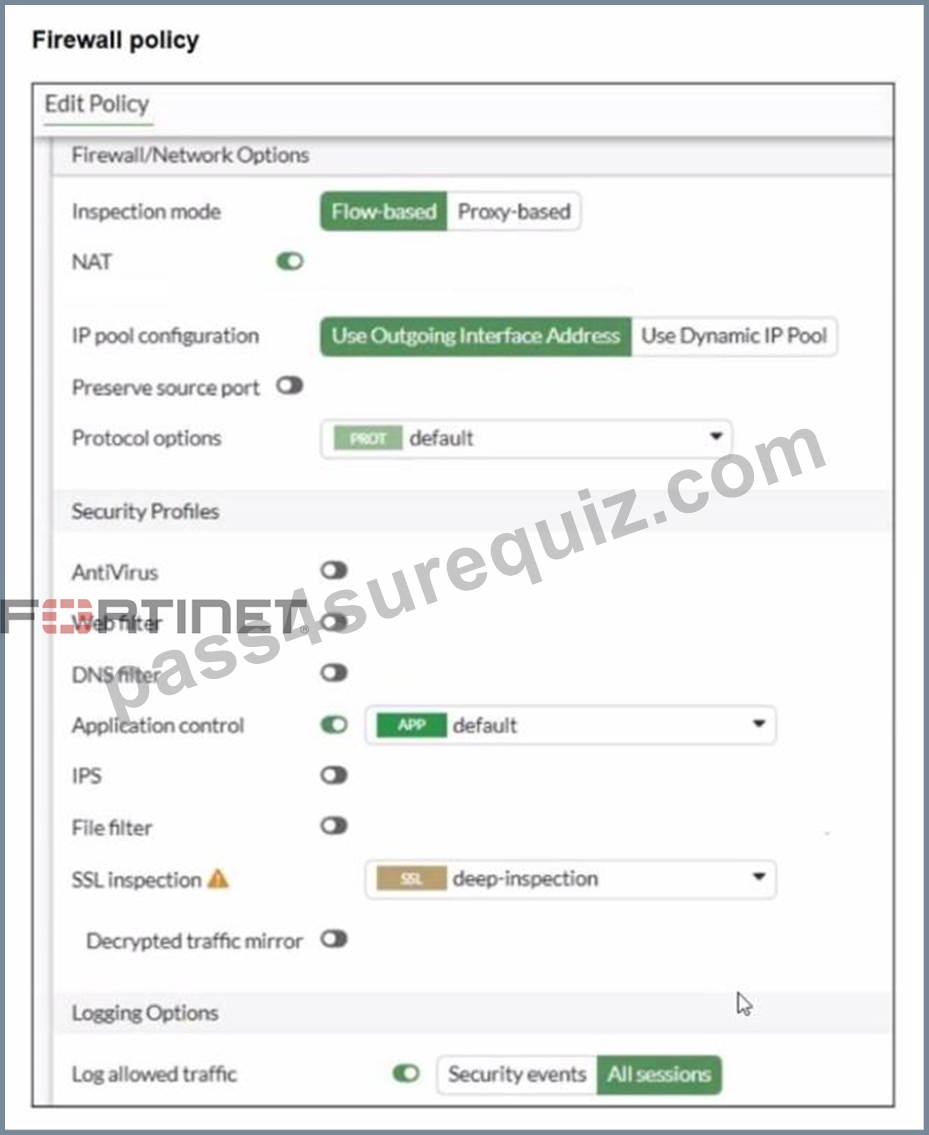
You have implemented the application sensor and the corresponding firewall policy as shown in the exhibits.
Which two factors can you observe from these configurations? (Choose two.)
- A. Facebook access is allowed but you cannot play Facebook videos based on Video/Audio category filter settings.
- B. Facebook access is blocked based on the category filter settings.
- C. YouTube search is allowed based on the Google Application and Filter override settings.
- D. YouTube access is blocked based on Excessive-Bandwidth Application and Filter override settings.
Answer: B,D
Explanation:
From the exhibits:
The Application Control sensor has these key settings:
Application and Filter Overrides
Priority 1: Excessive-Bandwidth (Type: Filter) with Action Block
Priority 2: Google (Type: Filter) with Action Monitor
Category actions shown include Social Media set to Block (this category includes Facebook).
The firewall policy is using:
Flow-based inspection
Application control enabled (profile: default)
Deep inspection enabled (helps identify applications inside HTTPS)
Logging enabled
FortiOS applies Application Control as follows (top-down within the Application Control profile):
Overrides are evaluated by priority (highest priority first).
The first matching override determines the action (block/monitor/allow) for that traffic.
Category-based actions apply to applications that fall into those categories unless an override matches first.
Why A is correct
A). YouTube access is blocked based on Excessive-Bandwidth Application and Filter override settings.
The profile explicitly blocks the Excessive-Bandwidth behavior filter at the highest override priority.
When YouTube traffic is detected as matching the Excessive-Bandwidth behavior, FortiGate will apply the Block action due to the override.
Because this is a priority override, it is enforced before lower-priority entries.
Why B is correct
B). Facebook access is blocked based on the category filter settings.
The Application Sensor shows Social Media configured with a Block action.
Facebook is categorized under Social Media, so it will be blocked when matched by Application Control.
Why C is not correct
C). Facebook access is allowed but you cannot play Facebook videos...
Since the Social Media category is set to Block, Facebook would be blocked at the category level (not merely video playback).
Why D is not correct
D). YouTube search is allowed based on the Google override...
The Google override action is Monitor, not Allow.
"Monitor" logs/detects but does not override a block condition to "allow" traffic.
Also, YouTube traffic is not guaranteed to be treated as "Google" in a way that would permit it, and any matching block condition (such as Excessive-Bandwidth) would still take precedence.
NEW QUESTION # 41
A FortiGate administrator enables SSL deep inspection on a policy but users report certificate warnings in their browsers. What is the most appropriate step to resolve this while keeping deep inspection active?
- A. Install the FortiGate CA certificate on client devices
- B. Disable all security profiles on the policy
- C. Change the policy action from ACCEPT to DENY
- D. Disable HTTPS scanning in the policy
Answer: A
Explanation:
When FortiGate performs SSL deep inspection, it substitutes the original server certificate with one it generates on the fly, signed by its internal CA. If endpoints do not trust that CA, they report errors. Deploying the FortiGate CA as a trusted root certificate on client machines resolves the warnings while retaining the ability to inspect encrypted traffic for malware, policy violations, and suspicious behavior.
NEW QUESTION # 42
An administrator configures FortiGuard servers as DNS servers on FortiGate using default settings.
What is true about the DNS connection to a FortiGuard server?
- A. It uses DNS over HTTPS.
- B. It uses DNS over TLS.
- C. It uses UDP 53.
- D. It uses UDP 8888.
Answer: C
Explanation:
When FortiGuard servers are configured as DNS servers on FortiGate with default settings, the DNS queries are sent using the standard DNS protocol over UDP port 53.
NEW QUESTION # 43
FortiGate is integrated with FortiAnalyzer and FortiManager.
When creating a firewall policy, which attribute must an administrator include to enhance functionality and enable log recording on FortiAnalyzer and FortiManager?
- A. Policy ID
- B. Sequence ID
- C. Universally Unique Identifier
- D. Log ID
Answer: C
Explanation:
In FortiOS 7.6, when FortiGate is integrated with FortiAnalyzer and FortiManager, firewall policies rely on a Universally Unique Identifier (UUID) to ensure proper policy tracking, synchronization, and log correlation across devices.
Why the UUID is required
Every firewall policy in FortiOS has a UUID.
FortiManager uses the UUID to:
Track policies across managed FortiGate devices
Maintain policy consistency during installs and revisions
FortiAnalyzer uses the UUID to:
Correlate logs accurately to the correct firewall policy
Preserve log association even if policy order or policy ID changes
Without a UUID:
Policy-to-log mapping can break
FortiManager cannot reliably manage or synchronize policies
FortiAnalyzer log analysis becomes inconsistent
This is explicitly documented in Fortinet administration and logging architecture references.
Why the other options are incorrect
B). Policy IDPolicy ID can change when policies are moved and is not reliable for long-term correlation across FortiManager and FortiAnalyzer.
C). Sequence IDSequence ID reflects GUI ordering only and has no role in log correlation.
D). Log IDLog ID is generated per log event, not per firewall policy.
NEW QUESTION # 44
What are two features of FortiGate FSSO agentless polling mode? (Choose two.)
- A. FortiGate does not support workstation check.
- B. FortiGate uses the SMB protocol to read the event viewer logs from the DCs.
- C. FortiGate directs the collector agent to use a remote LDAP server.
- D. FortiGate uses the AD server as the collector agent.
Answer: A,B
Explanation:
Based on the FortiOS 7.6 Administrator Guide regarding Fortinet Single Sign-On (FSSO) polling modes, the agentless polling mode has specific technical characteristics:
SMB Protocol Usage (Statement B is True):
In agentless polling mode, the FortiGate unit itself acts as the collector.
It establishes direct connections to the Windows Domain Controllers (DCs) using the SMB (Server Message Block) protocol, typically over TCP port 445, to read the Windows Security Event logs.
This allows FortiGate to parse login event IDs (such as 4768 and 4769) to identify users and their corresponding IP addresses without needing an external collector agent installed on a server.
Workstation Check Support (Statement C is True):
One of the primary limitations of the agentless polling mode compared to the agent-based mode is the lack of workstation verification.
In agentless mode, FortiGate does not perform "workstation checks" or "dead entry checks". This means it cannot proactively verify if a user is still logged into a specific workstation after the initial logon event is recorded, which can lead to stale entries if a user logs off without a corresponding event being captured.
Why other options are incorrect:
Option A: In agentless mode, FortiGate (the FSSO daemon) performs the collection itself; it does not use the AD server as a "collector agent" in the functional sense of FSSO architecture.
Option D: While FortiGate uses LDAP to retrieve group membership information once a user is identified, it does not "direct" a collector agent to a remote LDAP server, as there is no external collector agent involved in this specific mode.
NEW QUESTION # 45
Refer to the exhibits.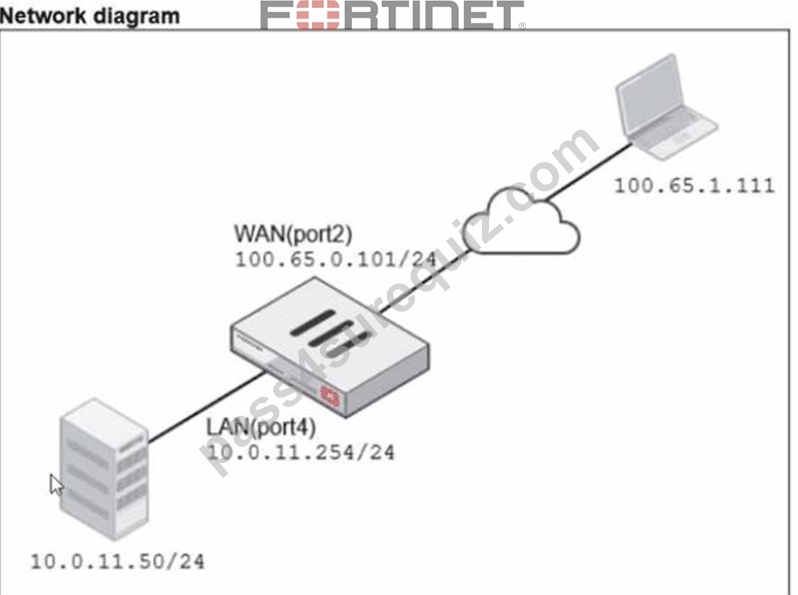
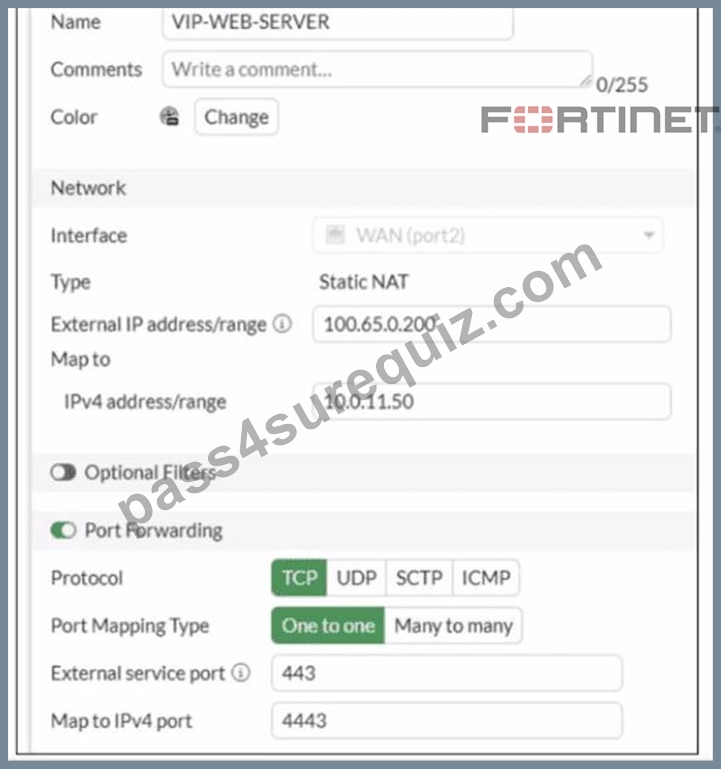

A diagram of a FortiGate device connected to the network VIP object and firewall policy configurations are shown.
The WAN (port2) interface has the IP address
100.65.0.101/24.
The LAN (port4) interface has the IP address
10.0.11.254/24.
If the host 100.65.1.111 sends a TCP SYN packet on port 443 to 100.65.0.200. what will the source address, destination address, and destination port of the packet be at the time FortiGate forwards the packet to the destination?
- A. 10.0.11.254, 100.65.0.200. and 443, respectively
- B. 100.65.1. 111, 10.0.11.50, and 4443. respectively
- C. 100.65.1.111, 10.0.11.50. and 443. respectively
- D. 10.0.11.254, 10.0.15.50, and 4443. respectively
Answer: B
Explanation:
From the exhibits:
A VIP named VIP-WEB-SERVER is configured on WAN (port2) with:
External IP: 100.65.0.200
Mapped (internal) IP: 10.0.11.50
Port forwarding enabled (TCP)
External service port: 443
Map to IPv4 port: 4443
The inbound firewall policy Web_Server_Access is:
From WAN (port2) to LAN (port4)
Destination: VIP-WEB-SERVER
Service: HTTPS
NAT: Disabled (meaning no source NAT is applied)
What happens to the packet
A host 100.65.1.111 sends TCP SYN dst-port 443 to 100.65.0.200.
When FortiGate matches the VIP and forwards traffic to the internal server, FortiGate performs destination NAT (DNAT) based on the VIP:
Source IP is unchanged because policy NAT is disabled:
Source remains 100.65.1.111
Destination IP is translated by the VIP:
Destination becomes 10.0.11.50
Destination port is translated by the VIP port-forward:
Destination port becomes 4443
Therefore, at the time FortiGate forwards the packet to the destination (internal server), it will be:
Source address: 100.65.1.111
Destination address: 10.0.11.50
Destination port: 4443
NEW QUESTION # 46
An administrator wants to address shadow IT visibility challenges and prevent users from sending sensitive files outside the organization without proper approval. Which FortiSASE method should the administrator implement to achieve these goals? (Choose one answer)
- A. Secure SaaS access (SSA)
- B. Secure private access (SPA)
- C. Secure SD-WAN access (SSD-WAN)
- D. Secure internet access (SIA)
Answer: A
Explanation:
"FortiSASE provides secure access to remote users for the following use cases:
* SIA enables secure web browsing for remote users to protect from known and unknown threats
* SPA enables explicit application access under a zero-trust access or with SD-WAN integration to ensure secure application access
* SSA addresses shadow IT visibility challenges and safeguards data loss prevention "
"FortiCASB provides cloud-based and API-based features to enable deep inspection of SaaS applications to enable detailed monitoring, analysis, and reporting features... Data loss prevention (DLP) helps to identify, monitor, and protect organizational data at rest and in motion. " Technical Deep Dive:
The correct answer is C. Secure SaaS access (SSA) .
The question gives two very specific requirements:
* Shadow IT visibility
* Prevent sensitive files from leaving the organization without approval The study guide maps both directly to SSA . In FortiSASE, SSA aligns with SaaS governance and CASB- style controls. That is the right architecture when you need visibility into sanctioned and unsanctioned SaaS usage, plus DLP controls for uploads, sharing, and file movement.
Why the other options are wrong:
* SIA focuses on securing internet browsing and remote web traffic.
* SPA is for explicit zero-trust access to private applications.
* SSD-WAN is not the FortiSASE method for SaaS visibility/DLP control.
In practice, SSA is the choice because it combines SaaS visibility, activity monitoring, and DLP-style enforcement . That lets an administrator detect shadow SaaS usage and apply controls such as blocking uploads, monitoring sharing events, or restricting file transfers based on policy. This is a CASB-oriented use case, not just generic web security.
NEW QUESTION # 47
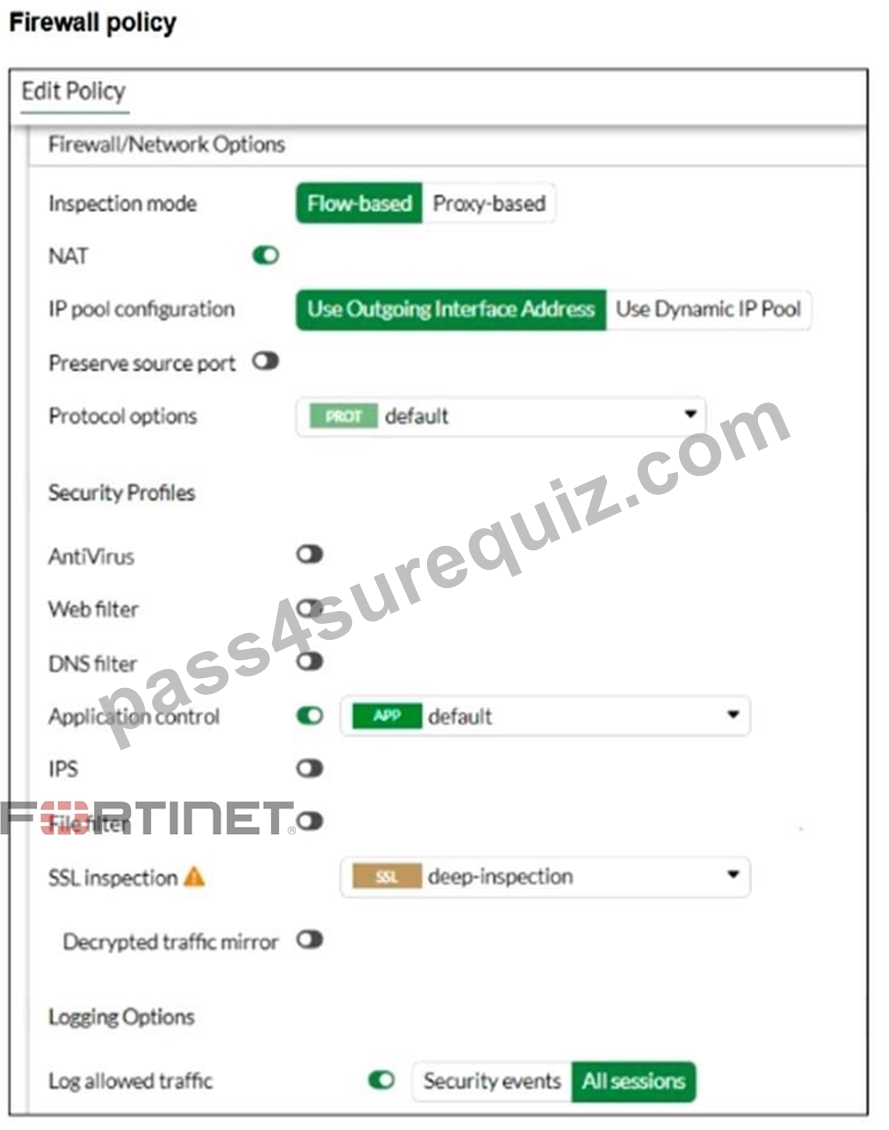
Refer to the exhibits. You have implemented the application sensor and the corresponding firewall policy as shown in the exhibits.
Which two factors can you observe from these configurations? (Choose two.)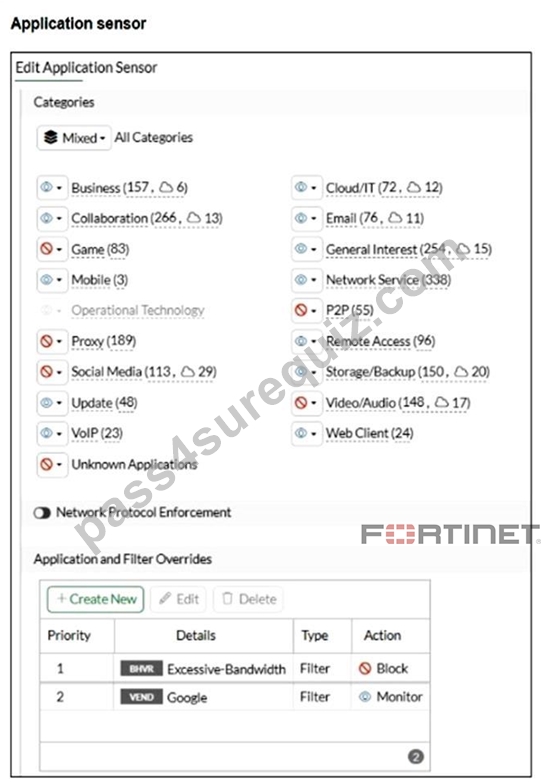
- A. Facebook access is blocked based on the category filter settings.
- B. YouTube access is blocked based on Excessive-Bandwidth Application and Filter override settings.
- C. YouTube search is allowed based on the Google Application and Filter override settings.
- D. Facebook access is allowed but you cannot play Facebook videos based on Video/Audio category filter settings.
Answer: C,D
Explanation:
Facebook belongs to the Social Media application category, which is set to Block in the application sensor. Therefore, any Facebook application traffic is blocked by category.
YouTube Search may fall under Google services or General Interest depending on how traffic is parsed (especially with SSL deep inspection).
The Google application override is set to Monitor, which means traffic is allowed, just logged.
The Video/Audio category (which includes YouTube video playback) is blocked, but this does not block YouTube Search, which is just browsing and searching on the site, is not blocked by the Video/Audio category unless the actual video stream starts.
NEW QUESTION # 48
A network administrator has configured an SSL/SSH inspection profile defined for full SSL inspection and set with a private CA certificate. The firewall policy that allows the traffic uses this profile for SSL inspection and performs web filtering. When visiting any HTTPS websites, the browser reports certificate warning errors.
What is the reason for the certificate warning errors?
- A. The browser does not recognize the certificate in use as signed by a trusted CA.
- B. The certificate used by FortiGate for SSL inspection does not contain the required certificate extensions.
- C. With full SSL inspection it is not possible to avoid certificate warning errors at the browser level.
- D. The SSL cipher compliance option is not enabled on the SSL inspection profile. This setting is required when the SSL inspection profile is defined with a private CA certificate.
Answer: A
Explanation:
The certificate warning errors occur because the SSL inspection profile is configured to use a private CA certificate that is not recognized by the browser as being signed by a trusted CA. For the browser to trust the FortiGate's re-signed certificates, the CA certificate used by FortiGate for SSL inspection must be installed in the browser's trusted certificate store. Until the browser recognizes the certificate authority (CA) as trusted, it will continue to display warning errors when accessing HTTPS websites.
NEW QUESTION # 49
There are multiple dialup IPsec VPNs configured in aggressive mode on the HQ FortiGate. The requirement is to connect dial-up users to their respective department VPN tunnels.
Which phase 1 setting you can configure to match the user to the tunnel?
- A. IKE Mode Config
- B. Dead Peer Detection
- C. Peer ID
- D. Local Gateway
Answer: C
Explanation:
In FortiOS 7.6, when multiple dialup IPsec VPNs are configured on the same FortiGate-especially in Aggressive Mode-FortiGate must identify which Phase 1 configuration a connecting client should match.
How FortiGate selects a dialup IPsec tunnel
For dialup VPNs:
The remote peer (user or device) does not have a fixed IP address
Multiple Phase 1 interfaces may exist on the HQ FortiGate
FortiGate uses identifying information sent during IKE Phase 1 to select the correct tunnel Aggressive Mode behavior Aggressive mode sends ID information in clear text during Phase 1 This allows FortiGate to match incoming peers to the correct Phase 1 configuration Why Peer ID is the correct answer C . Peer ID Peer ID (also called IKE ID) is used to:
Identify the remote peer
Differentiate between multiple dialup tunnels
Common Peer ID formats:
FQDN
User FQDN
Key ID
FortiGate matches the received Peer ID against the Phase 1 configuration to select the correct tunnel This is the documented and recommended method for:
Mapping users to different department tunnels
Supporting multiple dialup IPsec VPNs in aggressive mode
Why the other options are incorrect
A . Local Gateway
Identifies the local FortiGate interface/IP, not the remote user.
B . Dead Peer Detection
Used only for tunnel health monitoring, not tunnel selection.
D . IKE Mode Config
Used for assigning IP addresses and pushing settings, not for selecting the Phase 1 tunnel.
NEW QUESTION # 50
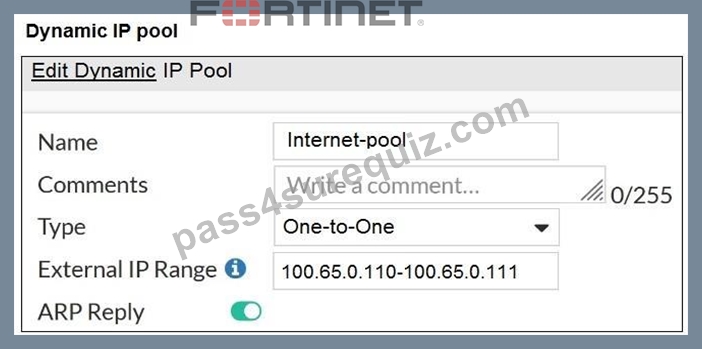
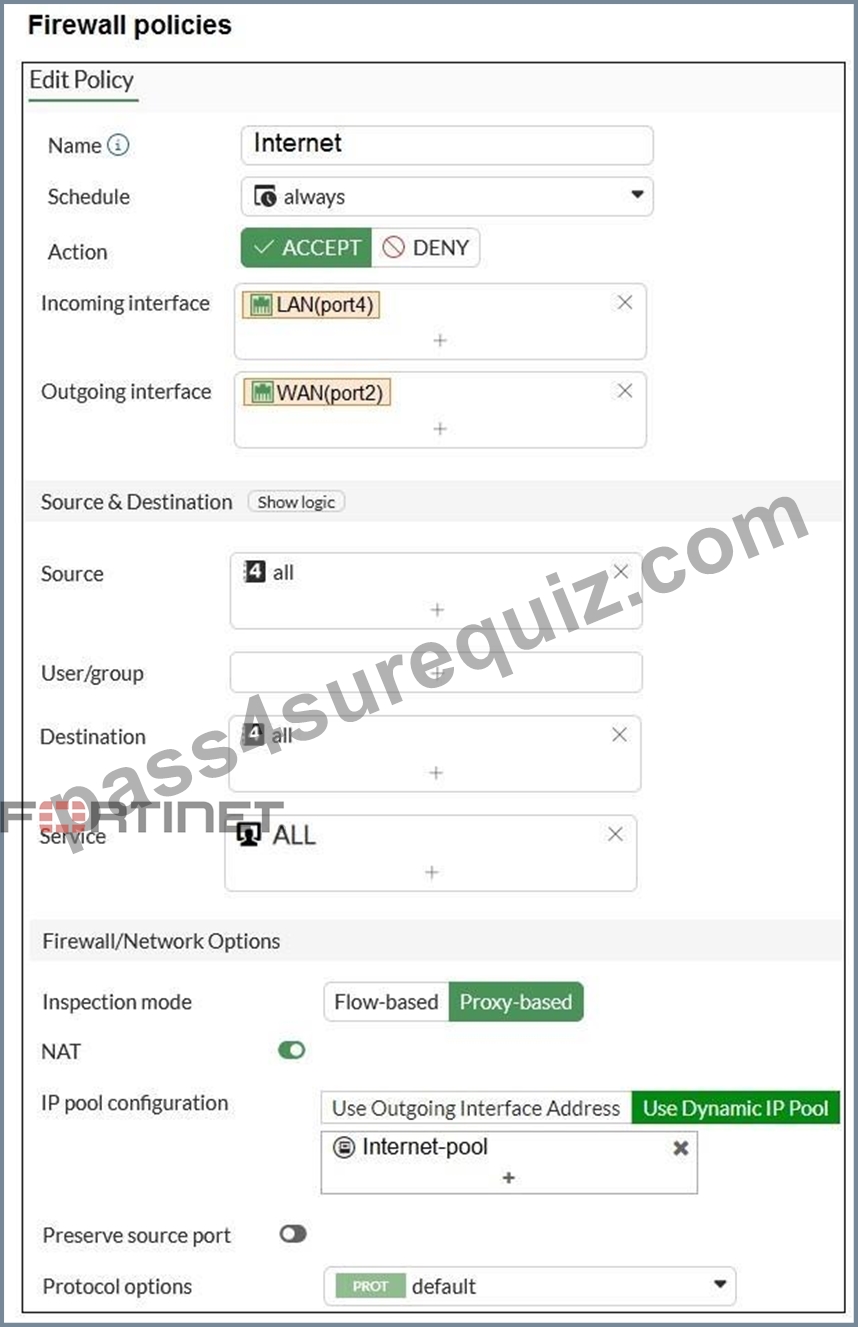
Refer to the exhibits. The exhibits show a diagram of a FortiGate device connected to the network, as well as the firewall policy and IP pool configuration on the FortiGate device.
Two PCs, PC1 and PC2, are connected behind FortiGate and can access the internet successfully. However, when the administrator adds a third PC to the network (PC3), the PC cannot connect to the internet.
Based on the information shown in the exhibit, which two configuration options can the administrator use to fix the connectivity issue for PC3? (Choose two.)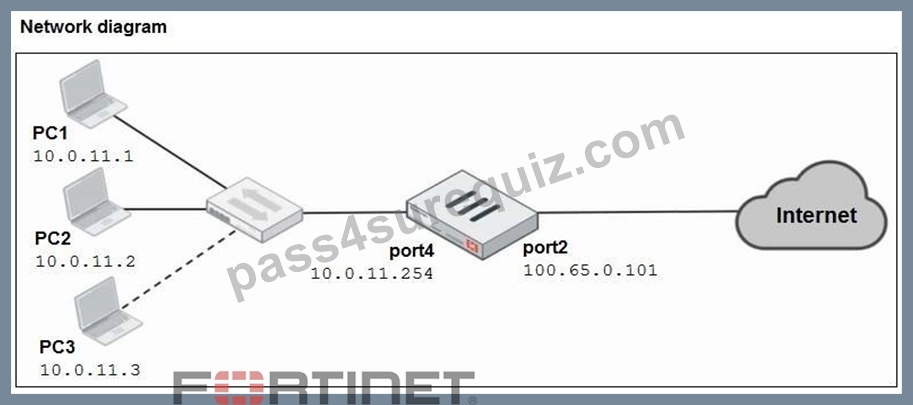
- A. In the firewall policy, set match-vipto enableusing CLI.
- B. In the IP pool configuration, set typeto overload.
- C. In the system settings, set Multiple Interface Policies to enable.
- D. In the IP pool configuration, set endipto 100.65.0.112.
Answer: B,D
Explanation:
The IP pool is configured as One-to-One with a range of only 100.65.0.110-100.65.0.111, which allows NAT for only two internal hosts (PC1 and PC2). When PC3 tries to access the internet, no external IP is available for mapping.
To fix this:
- Change the IP pool type to Overload, allowing multiple internal IPs to share a single external IP.
- Expand the IP pool range by setting endip to 100.65.0.112 (or more) so that additional internal hosts (like PC3) can also be assigned a unique external IP.
NEW QUESTION # 51
A network administrator is reviewing firewall policies in both Interface Pair View and By Sequence View.
The policies appear in a different order in each view. Why is the policy order different in these two views?
- A. Interface Pair View sorts policies based on matching interfaces, while By Sequence View shows the actual processing order of rules.
- B. The firewall dynamically reorders policies in Interface Pair View based on recent traffic patterns, but By Sequence View remains static.
- C. By Sequence View groups policies based on rule priority, while Interface Pair View always follows the order of traffic logs.
- D. Policies in Interface Pair View are prioritized by security levels, while By Sequence View strictly follows the administrator's manual ordering.
Answer: A
Explanation:
In FortiOS 7.6, firewall policies can be displayed in multiple views to help administrators understand and manage rules more effectively. The difference in ordering between Interface Pair View and By Sequence View is intentional and documented.
Why the policy order is different
Interface Pair View
Groups firewall policies based on the incoming (From) and outgoing (To) interfaces.
Policies are organized under interface pairs such as:
LAN # WAN
WAN # LAN
Within each interface pair, policies may appear reordered compared to the global list.
This view is designed for readability and troubleshooting, not to show execution order.
By Sequence View
Displays firewall policies in their actual evaluation (processing) order.
This is the top-down order FortiGate uses when matching traffic.
It reflects the real rule sequence that determines which policy is hit first.
Why option C is correct
C). Interface Pair View sorts policies based on matching interfaces, while By Sequence View shows the actual processing order of rules.
This statement exactly matches FortiOS behavior as documented in the FortiOS 7.6 Firewall Policy Views section of the Administrator Guide.
Why the other options are incorrect
A: Interface Pair View does not follow traffic logs, and By Sequence View is not based on "rule priority" grouping.
B: FortiGate does not dynamically reorder policies based on traffic patterns.
D: Security levels do not affect policy ordering in Interface Pair View.
NEW QUESTION # 52
A network administrator is configuring an IPsec VPN tunnel for a sales employee travelling abroad.
Which IPsec Wizard template must the administrator apply?
- A. Remote Access
- B. Dial up User
- C. Site to Site
- D. Hub-and-Spoke
Answer: A
Explanation:
The Remote Access IPsec Wizard template is used for individual users connecting from remote locations, such as traveling employees. This template configures FortiGate to act as an IPsec VPN server, allowing remote clients (like FortiClient) to securely connect and access internal network resources while abroad.
NEW QUESTION # 53
Refer to the exhibit. Why is the Antivirus scan switch grayed out when you are creating a new antivirus profile for FTP?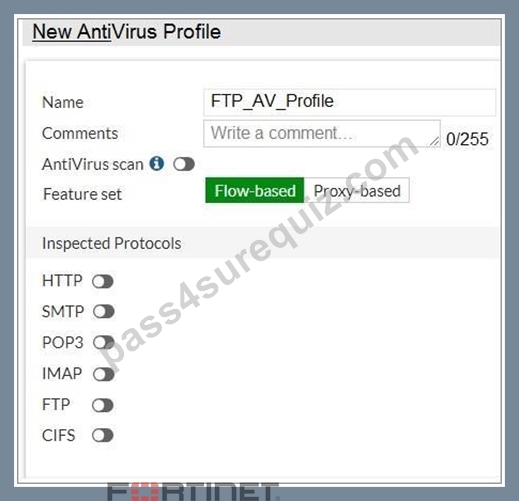
- A. Antivirus scan is disabled under System -> Feature visibility.
- B. None of the inspected protocols are active in this profile.
- C. The Feature Set for the profile is Flow-based but it must be Proxy-based.
- D. FortiGate, with less than 2 GB RAM, does not support the Antivirus scan feature.
Answer: B
Explanation:
Enable one or more protocols for inspection, then enable AntiVirus scan for the selected protocols with a specified action.
https://docs.fortinet.com/document/fortigate/7.6.4/administration-guide/922096/inspection-mode- feature-comparison
NEW QUESTION # 54
......
Fortinet NSE4_FGT_AD-7.6 Exam Syllabus Topics:
| Topic | Details |
|---|---|
| Topic 1 |
|
| Topic 2 |
|
| Topic 3 |
|
| Topic 4 |
|
| Topic 5 |
|
Pass Fortinet NSE4_FGT_AD-7.6 Exam in First Attempt Guaranteed: https://certkingdom.pass4surequiz.com/NSE4_FGT_AD-7.6-exam-quiz.html