

Positive Aspects of Valid Dumps 300-740 Exam Dumps! [Sep-2025]
First Attempt Guaranteed Success in 300-740 Exam 2025
NEW QUESTION # 118 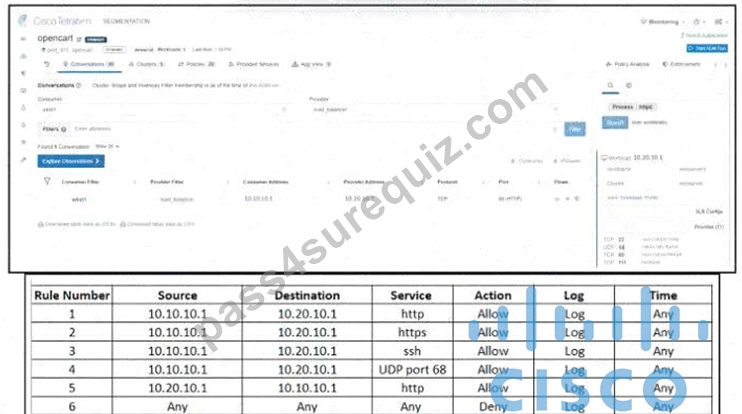
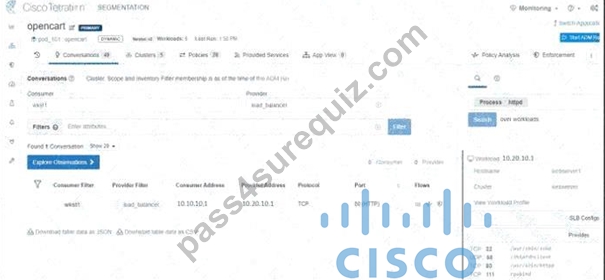
Refer to the exhibit. An engineer must create a firewall policy to allow web server communication only. The indicated firewall policy was applied; however, a recent audit requires that all firewall policies be optimized.
Which set of rules must be deleted?
- A. Rules 2 to 5
- B. Rules 2 to 4
- C. Rules 3 and 4
- D. Rules 1 and 5
Answer: C
Explanation:
Based on the Cisco Tetration segmentation policy and the requirement to allow only web server communication (HTTP/HTTPS):
Rule 1 allows HTTP (port 80) - required
Rule 2 allows HTTPS (port 443) - required
Rule 3 allows SSH - not needed for web communication
Rule 4 allows UDP port 68 (DHCP) - not relevant to application-layer web server traffic Therefore, Rules 3 and 4 are unnecessary and should be deleted for policy optimization, which aligns with zero-trust and least-privilege access design as outlined in SCAZT Section 4 (Application and Data Security, Pages 86-90).
Reference: Designing and Implementing Secure Cloud Access for Users and Endpoints (SCAZT), Section 4, Pages 86-90
NEW QUESTION # 119
A security analyst detects an employee endpoint making connections to a malicious IP on the internet and downloaded a file named Test0511127691C.pdf. The analyst discovers the machine is infected by trojan malware. What must the analyst do to mitigate the threat using Cisco Secure Endpoint?
- A. Start isolation of the machine on the Computers tab
- B. Enable scheduled scans to detect and block the executable files
- C. Create an IP Block list and add the IP address of the affected endpoint
- D. Identify the malicious IPs and place them in a blocked list
Answer: A
Explanation:
In Cisco Secure Endpoint (formerly AMP for Endpoints), isolating an infected machine is the most immediate action to contain the threat. Isolation cuts the endpoint off from all network communication except to the management console, allowing the analyst to investigate further while preventing lateral movement or data exfiltration.
According to SCAZT Section 6: Threat Response (Pages 114-117), isolation is a recommended first response in the event of malware detection.
Reference: Designing and Implementing Secure Cloud Access for Users and Endpoints (SCAZT), Section 6, Pages 114-117
NEW QUESTION # 120
Which of the following is true about lateral movement prevention strategies?
- A. They primarily focus on external firewall configuration
- B. They encourage the use of shared credentials
- C. They are only applicable in on-premises environments
- D. They include the use of just-in-time access and privilege escalation monitoring
Answer: D
NEW QUESTION # 121
The function of a reverse proxy includes:
- A. Directly exposing internal network architecture to the internet
- B. Decreasing the security of web applications
- C. Acting as an intermediary for requests from clients seeking resources from servers
- D. Slowing down the access to web services
Answer: C
NEW QUESTION # 122
In the context of cloud security, NIST framework primarily provides:
- A. Network performance metrics
- B. Physical security guidelines
- C. Standards and guidelines for cybersecurity practices
- D. Data encryption algorithms
Answer: C
NEW QUESTION # 123 
Refer to the exhibit. A security engineer deployed Cisco Secure XDR, and during testing, the log entry shows a security incident. Which action must the engineer take first?
- A. Uninstall the malware.
- B. Rebuild the endpoint.
- C. Isolate the endpoint.
- D. Block IP address 10.77.17.45.
Answer: C
Explanation:
The SCAZT documentation emphasizes that when Cisco Secure XDR identifies a high-risk threat (e.g., risk score 8 out of 10 for malware distribution, as shown in the exhibit), the first priority is to prevent lateral movement and data exfiltration. The recommended first response action is to isolate the affected endpoint from the network.
Cisco Secure Endpoint and XDR allow you to trigger an "isolate" response directly from the dashboard, cutting off all non-management communication from the compromised device. This preserves the environment and enables forensic analysis before removing malware or taking destructive actions like rebuilding the system.
Reference: Designing and Implementing Secure Cloud Access for Users and Endpoints (SCAZT), Section 6:
Threat Response, Pages 113-118
NEW QUESTION # 124
OIDC stands for OpenID Connect.
What is it used for in the context of identity management?
- A. To authenticate users by leveraging an identity provider
- B. To track user activity on websites
- C. To encrypt device data
- D. To connect to open networks
Answer: A
NEW QUESTION # 125
In the context of cloud security, which of the following is a recommended mitigation strategy against account takeover attacks?
- A. Regularly decreasing permissions and access rights
- B. Sharing credentials among team members for convenience
- C. Use of simple passwords
- D. Implementation of multi-factor authentication (MFA)
Answer: D
NEW QUESTION # 126
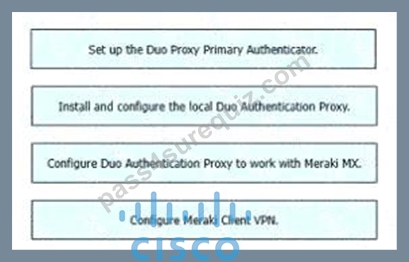
Drag and drop the tasks from the left into order on the right to implement adding Duo multifactor authentication to Meraki Client VPN login.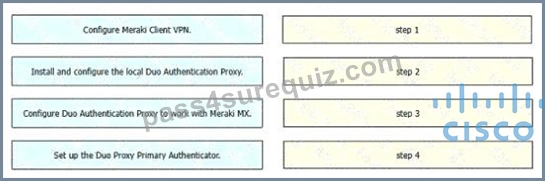
Answer:
Explanation: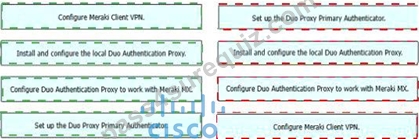
NEW QUESTION # 127
An engineer is configuring multifactor authentication using Duo. The implementation must use Duo Authentication Proxy and the Active Directory as an identity source. The company uses Azure and a local Active Directory. Which configuration is needed to meet the requirement?
- A. Configure the Identity Source as "Active Directory" on the Single Sign-On tab in the Duo Admin Panel, and configure the permit list to "Local database".
- B. Configure the Identity Source as "SAML" on the Single Sign-On tab, and configure the authentication proxy with the "[cloud]" section.
- C. Configure the Identity Source as "SAML" on the Single Sign-On tab in the Duo Admin Panel, and configure the forwarding proxy as "local" for the Identity Source.
- D. Configure the Identity Source as "Active Directory" on the Single Sign-On tab, and configure the authentication proxy with the "[sso]" section.
Answer: D
Explanation:
When integrating Duo Authentication Proxy with Active Directory for multifactor authentication (MFA), you must:
Configure the Identity Source in the Duo Admin Panel as Active Directory (not SAML), since it's using the Authentication Proxy.
Configure the authentication proxy settings in the [sso] section to communicate with both AD and the Duo cloud.
This setup allows Active Directory to be the primary identity store while Duo provides the second authentication factor.
Reference: Designing and Implementing Secure Cloud Access for Users and Endpoints (SCAZT), Section 2:
User and Device Security, Pages 40-45
NEW QUESTION # 128
CISA guidelines in cloud security architecture focus on:
- A. Designing physical devices for network security
- B. Improving software development practices
- C. Offering financial advice to IT companies
- D. Strengthening cybersecurity infrastructure and response
Answer: D
NEW QUESTION # 129
Which tool is specifically designed for analyzing application dependencies and network traffic to ensure security and compliance?
- A. Cisco Secure Workload
- B. All of the above
- C. Cisco Duo
- D. Cisco Umbrella
Answer: A
NEW QUESTION # 130
Response automation tools help in:
- A. Complicating incident response procedures
- B. Slowing down the detection of malware
- C. Quickly isolating infected devices from the network
- D. Increasing the number of false positives
Answer: C
NEW QUESTION # 131
What is associated with implementing Cisco zero-trust architecture?
- A. It verifies trust before granting access to resources.
- B. It provides the same security as the VPN technology.
- C. It assumes that all network traffic is trustworthy.
- D. It focuses on perimeter-based security.
Answer: A
Explanation:
Zero Trust is based on the concept of "never trust, always verify." It ensures that no user or device is inherently trusted, even if they are inside the corporate network. Cisco's Zero Trust Architecture implements continuous trust verification for every access request, using identity, device posture, and behavior analysis.
SCAZT Section 1 (Cloud Security Architecture, Pages 13-17) describes how Cisco's Zero Trust model authenticates and authorizes access before permitting resource interaction.
Reference: Designing and Implementing Secure Cloud Access for Users and Endpoints (SCAZT), Section 1, Pages 13-17
=========
NEW QUESTION # 132 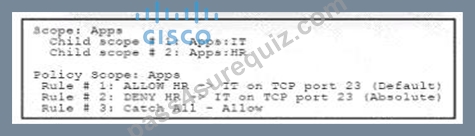
Refer to the exhibit. An engineer must analyze a segmentation policy in Cisco Secure Workload. What is the result of applying the policy?
- A. The default catch-all rule is applied by using Rule #3.
- B. HR can use Telnet to connect to IT by using Rule #1.
- C. The explicit deny all rule is applied.
- D. HR cannot use Telnet to connect to IT by using Rule #2.
Answer: D
Explanation:
The policy includes three rules under the Apps scope. Rule #1 allows HR to communicate with IT on TCP port 23 (Telnet), but it is marked as "Default." Rule #2 denies the same HR-to-IT Telnet traffic and is marked as "Absolute," which takes precedence over any default rule. In Cisco Secure Workload (Tetration), an
"Absolute" rule will override both "Default" and inherited rules. Therefore, even though there's an allow in Rule #1, the deny in Rule #2 prevents HR from using Telnet to connect to IT.
Reference: Designing and Implementing Secure Cloud Access for Users and Endpoints (SCAZT), Section 5:
Visibility and Assurance, Pages 95-98.
NEW QUESTION # 133
......
Cisco 300-740 Exam Syllabus Topics:
| Topic | Details |
|---|---|
| Topic 1 |
|
| Topic 2 |
|
| Topic 3 |
|
| Topic 4 |
|
| Topic 5 |
|
| Topic 6 |
|
| Topic 7 |
|
| Topic 8 |
|
| Topic 9 |
|
Practice LATEST 300-740 Exam Updated 201 Questions: https://certkingdom.pass4surequiz.com/300-740-exam-quiz.html