

CKAD Questions Prepare with Learning Information! 2024 Regularly updated
Get CKAD Products Practice Material for CKAD Exam Question Preparation
Earning the CKAD certification demonstrates an individual's knowledge and skills in Kubernetes and cloud-native application development, making them a valuable asset to any organization. Linux Foundation Certified Kubernetes Application Developer Exam certification is valid for two years, after which candidates must renew their certification to stay up to date with the latest developments in Kubernetes and cloud-native technologies. The CKAD certification is an excellent way for developers and IT professionals to validate their skills and advance their careers in the rapidly growing field of cloud-native application development.
The CKAD Exam is a 2-hour, performance-based exam that consists of 19 questions. CKAD exam is conducted on a live Kubernetes cluster, and candidates are required to perform hands-on tasks using the command line interface. CKAD exam is designed to test the candidate's ability to perform real-world tasks in a Kubernetes environment.
NEW QUESTION # 12 
Task:
A pod within the Deployment named buffale-deployment and in namespace gorilla is logging errors.
1) Look at the logs identify errors messages.
Find errors, including User "system:serviceaccount:gorilla:default" cannot list resource "deployment" [...] in the namespace "gorilla"
2) Update the Deployment buffalo-deployment to resolve the errors in the logs of the Pod.
The buffalo-deployment 'S manifest can be found at -/prompt/escargot/buffalo-deployment.yaml See the solution below.
Answer:
Explanation:
Explanation
Solution:
Text Description automatically generated

Text Description automatically generated

Text Description automatically generated


Text Description automatically generated
NEW QUESTION # 13
Task:
Modify the existing Deployment named broker-deployment running in namespace quetzal so that its containers.
1) Run with user ID 30000 and
2) Privilege escalation is forbidden
The broker-deployment is manifest file can be found at:
Answer:
Explanation:
See the solution below.
Explanation
Solution:
Text Description automatically generated

NEW QUESTION # 14
Refer to Exhibit.
Task:
1- Update the Propertunel scaling configuration of the Deployment web1 in the ckad00015 namespace setting maxSurge to 2 and maxUnavailable to 59
2- Update the web1 Deployment to use version tag 1.13.7 for the Ifconf/nginx container image.
3- Perform a rollback of the web1 Deployment to its previous version
Answer:
Explanation:
Solution:


NEW QUESTION # 15
Context
Context
You are asked to prepare a Canary deployment for testing a new application release.
Task:
A Service named krill-Service in the goshark namespace points to 5 pod created by the Deployment named current-krill-deployment
1) Create an identical Deployment named canary-kill-deployment, in the same namespace.
2) Modify the Deployment so that:
-A maximum number of 10 pods run in the goshawk namespace.
-40% of the krill-service 's traffic goes to the canary-krill-deployment pod(s)
Answer:
Explanation:
Solution:


NEW QUESTION # 16
Exhibit:
Task
You are required to create a pod that requests a certain amount of CPU and memory, so it gets scheduled to-a node that has those resources available.
* Create a pod named nginx-resources in the pod-resources namespace that requests a minimum of 200m CPU and 1Gi memory for its container
* The pod should use the nginx image
* The pod-resources namespace has already been created
- A. Solution:


- B. Solution:

Answer: B
NEW QUESTION # 17
Context
Task
A Deployment named backend-deployment in namespace staging runs a web application on port 8081.
Answer:
Explanation:
Solution:


NEW QUESTION # 18
Context
Anytime a team needs to run a container on Kubernetes they will need to define a pod within which to run the container.
Task
Please complete the following:
* Create a YAML formatted pod manifest
/opt/KDPD00101/podl.yml to create a pod named app1 that runs a container named app1cont using image Ifccncf/arg-output with these command line arguments: -lines 56 -F
* Create the pod with the kubect1 command using the YAML file created in the previous step
* When the pod is running display summary data about the pod in JSON format using the kubect1 command and redirect the output to a file named /opt/KDPD00101/out1.json
* All of the files you need to work with have been created, empty, for your convenience
Answer:
Explanation:
Solution:


NEW QUESTION # 19
Task:
1) Fix any API depreciation issues in the manifest file -/credible-mite/www.yaml so that this application can be deployed on cluster K8s.
2) Deploy the application specified in the updated manifest file -/credible-mite/www.yaml in namespace cobra See the solution below.
Answer:
Explanation:
Explanation
Solution:
Text Description automatically generated
Text Description automatically generated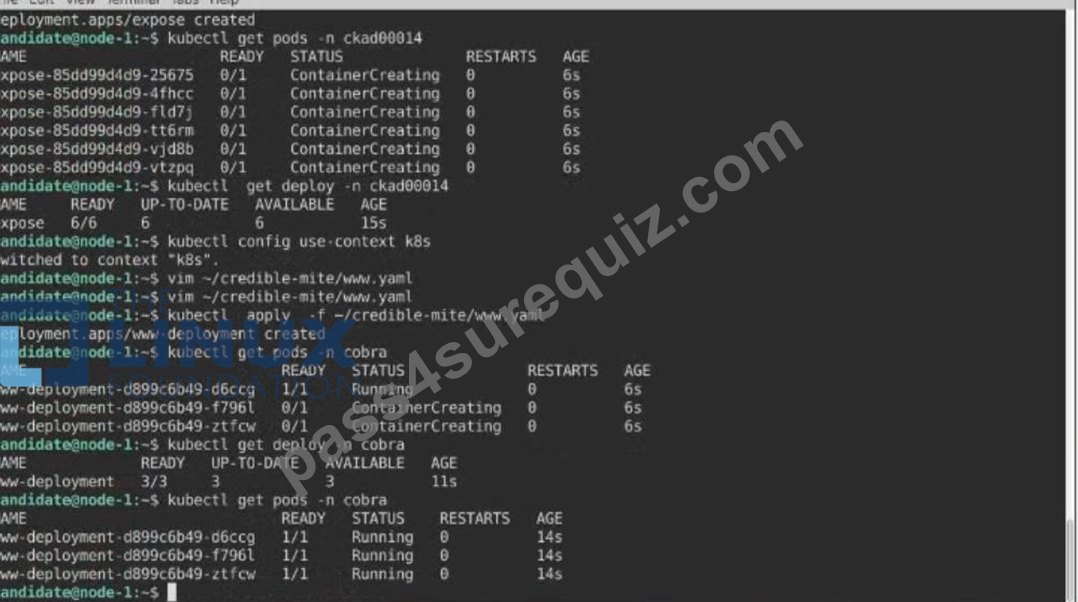
NEW QUESTION # 20
Task:
Create a Deployment named expose in the existing ckad00014 namespace running 6 replicas of a Pod. Specify a single container using the ifccncf/nginx: 1.13.7 image Add an environment variable named NGINX_PORT with the value 8001 to the container then expose port
8001
Answer:
Explanation:
See the solution below.
Explanation
Solution:
Text Description automatically generated
Text Description automatically generated
NEW QUESTION # 21
Exhibit:
Context
A project that you are working on has a requirement for persistent data to be available.
Task
To facilitate this, perform the following tasks:
* Create a file on node sk8s-node-0 at /opt/KDSP00101/data/index.html with the content Acct=Finance
* Create a PersistentVolume named task-pv-volume using hostPath and allocate 1Gi to it, specifying that the volume is at /opt/KDSP00101/data on the cluster's node. The configuration should specify the access mode of ReadWriteOnce . It should define the StorageClass name exam for the PersistentVolume , which will be used to bind PersistentVolumeClaim requests to this PersistenetVolume.
* Create a PefsissentVolumeClaim named task-pv-claim that requests a volume of at least 100Mi and specifies an access mode of ReadWriteOnce
* Create a pod that uses the PersistentVolmeClaim as a volume with a label app: my-storage-app mounting the resulting volume to a mountPath /usr/share/nginx/html inside the pod

- A. Solution:


- B. Solution:
Answer: A
NEW QUESTION # 22
Refer to Exhibit.
Task:
A Dockerfile has been prepared at -/human-stork/build/Dockerfile
1) Using the prepared Dockerfile, build a container image with the name macque and lag 3.0. You may install and use the tool of your choice.
2) Using the tool of your choice export the built container image in OC-format and store it at -/human stork/macque 3.0 tar
Answer:
Explanation:
Solution:


NEW QUESTION # 23 
Context
You sometimes need to observe a pod's logs, and write those logs to a file for further analysis.
Task
Please complete the following;
* Deploy the counter pod to the cluster using the provided YAMLspec file at /opt/KDOB00201/counter.yaml
* Retrieve all currently available application logs from the running pod and store them in the file
/opt/KDOB0020l/log_Output.txt, which has already been created
Answer:
Explanation:
See the solution below.
Explanation
Solution:


NEW QUESTION # 24
Refer to Exhibit.
Task
A Deployment named backend-deployment in namespace staging runs a web application on port 8081.
Answer:
Explanation:
Solution:


NEW QUESTION # 25 
Context
Your application's namespace requires a specific service account to be used.
Task
Update the app-a deployment in the production namespace to run as the restrictedservice service account. The service account has already been created.
Answer:
Explanation:
See the solution below.
Explanation
Solution:
NEW QUESTION # 26
Refer to Exhibit.
Task
You are required to create a pod that requests a certain amount of CPU and memory, so it gets scheduled to-a node that has those resources available.
* Create a pod named nginx-resources in the pod-resources namespace that requests a minimum of 200m CPU and 1Gi memory for its container
* The pod should use the nginx image
* The pod-resources namespace has already been created
Answer:
Explanation:
Solution:


NEW QUESTION # 27 
Context
Developers occasionally need to submit pods that run periodically.
Task
Follow the steps below to create a pod that will start at a predetermined time and]which runs to completion only once each time it is started:
* Create a YAML formatted Kubernetes manifest /opt/KDPD00301/periodic.yaml that runs the following shell command: date in a single busybox container. The command should run every minute and must complete within 22 seconds or be terminated oy Kubernetes. The Cronjob namp and container name should both be hello
* Create the resource in the above manifest and verify that the job executes successfully at least once See the solution below.
Answer:
Explanation:
Explanation
Solution:


NEW QUESTION # 28
......
Most Reliable Linux Foundation CKAD Training Materials: https://certkingdom.pass4surequiz.com/CKAD-exam-quiz.html