

Download DP-100 Dumps (2023) - Free PDF Exam Demo
Enhance your career with DP-100 PDF Dumps - True Microsoft Exam Questions
Microsoft DP-100 Practice Test Questions, Microsoft DP-100 Exam Practice Test Questions
The Microsoft DP-100: Designing & Implementing a Data Science Solution on Azure exam evaluates the skills and knowledge of the professionals in a range of technical tasks. These include training models and running experiments, setting up an Azure ML workspace, consuming and deploying models, and managing & optimizing models. This test is the only qualifying exam that leads to the Microsoft Certified: Azure Data Scientist Associate certification.
NEW QUESTION # 48
You are producing a multiple linear regression model in Azure Machine Learning Studio.
Several independent variables are highly correlated.
You need to select appropriate methods for conducting effective feature engineering on all the data.
Which three actions should you perform in sequence? To answer, move the appropriate actions from the list of actions to the answer area and arrange them in the correct order.
Answer:
Explanation:
Explanation:
Step 1: Use the Filter Based Feature Selection module
Filter Based Feature Selection identifies the features in a dataset with the greatest predictive power.
The module outputs a dataset that contains the best feature columns, as ranked by predictive power. It also outputs the names of the features and their scores from the selected metric.
Step 2: Build a counting transform
A counting transform creates a transformation that turns count tables into features, so that you can apply the transformation to multiple datasets.
Step 3: Test the hypothesis using t-Test
References:
https://docs.microsoft.com/bs-latn-ba/azure/machine-learning/studio-module-reference/filter-based-feature-selection
https://docs.microsoft.com/en-us/azure/machine-learning/studio-module-reference/build-counting-transform
NEW QUESTION # 49
You create a multi-class image classification deep learning model.
The model must be retrained monthly with the new image data fetched from a public web portal. You create an Azure Machine Learning pipeline to fetch new data, standardize the size of images, and retrain the model.
You need to use the Azure Machine Learning SDK to configure the schedule for the pipeline.
Which four actions should you perform in sequence. To answer, move the appropriate actions from the list of actions to the answer area and arrange them in the correct order.
Answer:
Explanation:
NEW QUESTION # 50
You must use the Azure Machine Learning SDK to interact with data and experiments in the workspace.
You need to configure the config.json file to connect to the workspace from the Python environment.
Which two additional parameters must you add to the config.json file in order to connect to the workspace? Each correct answer presents part of the solution.
NOTE: Each correct selection is worth one point.
- A. Login
- B. region
- C. Key
- D. resource_group
- E. subscription_Id
Answer: B,E
Explanation:
Topic 1, Case Study
Overview
You are a data scientist in a company that provides data science for professional sporting events. Models will be global and local market data to meet the following business goals:
* Understand sentiment of mobile device users at sporting events based on audio from crowd reactions.
* Access a user's tendency to respond to an advertisement.
* Customize styles of ads served on mobile devices.
* Use video to detect penalty events.
Current environment
Requirements
* Media used for penalty event detection will be provided by consumer devices. Media may include images and videos captured during the sporting event and snared using social media. The images and videos will have varying sizes and formats.
* The data available for model building comprises of seven years of sporting event media. The sporting event media includes: recorded videos, transcripts of radio commentary, and logs from related social media feeds feeds captured during the sporting events.
* Crowd sentiment will include audio recordings submitted by event attendees in both mono and stereo Formats.
Advertisements
* Ad response models must be trained at the beginning of each event and applied during the sporting event.
* Market segmentation nxxlels must optimize for similar ad resporr.r history.
* Sampling must guarantee mutual and collective exclusivity local and global segmentation models that share the same features.
* Local market segmentation models will be applied before determining a user's propensity to respond to an advertisement.
* Data scientists must be able to detect model degradation and decay.
* Ad response models must support non linear boundaries features.
* The ad propensity model uses a cut threshold is 0.45 and retrains occur if weighted Kappa deviates from 0.1 +/-5%.
* The ad propensity model uses cost factors shown in the following diagram:
The ad propensity model uses proposed cost factors shown in the following diagram:
Performance curves of current and proposed cost factor scenarios are shown in the following diagram: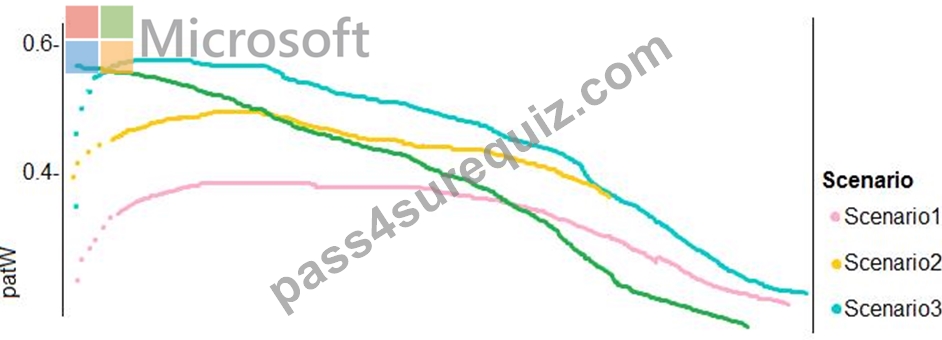
Penalty detection and sentiment
Findings
* Data scientists must build an intelligent solution by using multiple machine learning models for penalty event detection.
* Data scientists must build notebooks in a local environment using automatic feature engineering and model building in machine learning pipelines.
* Notebooks must be deployed to retrain by using Spark instances with dynamic worker allocation
* Notebooks must execute with the same code on new Spark instances to recode only the source of the data.
* Global penalty detection models must be trained by using dynamic runtime graph computation during training.
* Local penalty detection models must be written by using BrainScript.
* Experiments for local crowd sentiment models must combine local penalty detection data.
* Crowd sentiment models must identify known sounds such as cheers and known catch phrases. Individual crowd sentiment models will detect similar sounds.
* All shared features for local models are continuous variables.
* Shared features must use double precision. Subsequent layers must have aggregate running mean and standard deviation metrics Available.
segments
During the initial weeks in production, the following was observed:
* Ad response rates declined.
* Drops were not consistent across ad styles.
* The distribution of features across training and production data are not consistent.
Analysis shows that of the 100 numeric features on user location and behavior, the 47 features that come from location sources are being used as raw features. A suggested experiment to remedy the bias and variance issue is to engineer 10 linearly uncorrected features.
Penalty detection and sentiment
* Initial data discovery shows a wide range of densities of target states in training data used for crowd sentiment models.
* All penalty detection models show inference phases using a Stochastic Gradient Descent (SGD) are running too stow.
* Audio samples show that the length of a catch phrase varies between 25%-47%, depending on region.
* The performance of the global penalty detection models show lower variance but higher bias when comparing training and validation sets. Before implementing any feature changes, you must confirm the bias and variance using all training and validation cases.
NEW QUESTION # 51
You have the following Azure subscriptions and Azure Machine Learning service work*spaces:
You need to obtain a reference to the mi-protect workspace
Solution: Run the following Python code.
Does the solution meet the goal?
- A. No
- B. Yes
Answer: B
NEW QUESTION # 52
You plan to use Hyperdrive to optimize the hyperparameters selected when training a model. You create the following code to define options for the hyperparameter experiment

For each of the following statements, select Yes if the statement is true. Otherwise, select No. NOTE: Each correct selection is worth one point.
Answer:
Explanation:
Explanation
Box 1: No
max_total_runs (50 here)
The maximum total number of runs to create. This is the upper bound; there may be fewer runs when the sample space is smaller than this value.
Box 2: Yes
Policy EarlyTerminationPolicy
The early termination policy to use. If None - the default, no early termination policy will be used.
Box 3: No
Discrete hyperparameters are specified as a choice among discrete values. choice can be:
one or more comma-separated values
a range object
any arbitrary list object
Reference:
https://docs.microsoft.com/en-us/python/api/azureml-train-core/azureml.train.hyperdrive.hyperdriveconfig
https://docs.microsoft.com/en-us/azure/machine-learning/how-to-tune-hyperparameters
NEW QUESTION # 53
You are performing feature engineering on a dataset.
You must add a feature named CityName and populate the column value with the text London.
You need to add the new feature to the dataset.
Which Azure Machine Learning Studio module should you use?
- A. Execute Python Script
- B. Edit Metadata
- C. Preprocess Text
- D. Latent Dirichlet Allocation
Answer: B
Explanation:
Typical metadata changes might include marking columns as features.
Reference:
https://docs.microsoft.com/en-us/azure/machine-learning/studio-module-reference/edit-metadata
NEW QUESTION # 54
Note: This question is part of a series of questions that present the same scenario. Each question in the series contains a unique solution that might meet the stated goals. Some question sets might have more than one correct solution, while others might not have a correct solution.
After you answer a question in this section, you will NOT be able to return to it. As a result, these questions will not appear in the review screen.
You train and register an Azure Machine Learning model.
You plan to deploy the model to an online endpoint.
You need to ensure that applications will be able to use the authentication method with a non-expiring artifact to access the model.
Solution:
Create a managed online endpoint and set the value of its auto_mode parameter to key. Deploy the model to the inline endpoint.
Does the solution meet the goal?
- A. No
- B. Yes
Answer: B
NEW QUESTION # 55
You create an experiment in Azure Machine Learning Studio. You add a training dataset that contains 10,000 rows. The first 9,000 rows represent class 0 (90 percent).
The remaining 1,000 rows represent class 1 (10 percent).
The training set is imbalances between two classes. You must increase the number of training examples for class 1 to 4,000 by using 5 data rows. You add the Synthetic Minority Oversampling Technique (SMOTE) module to the experiment.
You need to configure the module.
Which values should you use? To answer, select the appropriate options in the dialog box in the answer area.
NOTE: Each correct selection is worth one point.
Answer:
Explanation:
Explanation:
Box 1: 300
You type 300 (%), the module triples the percentage of minority cases (3000) compared to the original dataset (1000).
Box 2: 5
We should use 5 data rows.
Use the Number of nearest neighbors option to determine the size of the feature space that the SMOTE algorithm uses when in building new cases. A nearest neighbor is a row of data (a case) that is very similar to some target case. The distance between any two cases is measured by combining the weighted vectors of all features.
By increasing the number of nearest neighbors, you get features from more cases.
By keeping the number of nearest neighbors low, you use features that are more like those in the original sample.
References:
https://docs.microsoft.com/en-us/azure/machine-learning/studio-module-reference/smote
NEW QUESTION # 56
space and set up a development environment. You plan to train a deep neural network (DNN) by using the Tensorflow framework and by using estimators to submit training scripts.
You must optimize computation speed for training runs.
You need to choose the appropriate estimator to use as well as the appropriate training compute target configuration.
Which values should you use? To answer, select the appropriate options in the answer area.
NOTE: Each correct selection is worth one point.
Answer:
Explanation:
Reference:
https://docs.microsoft.com/en-us/python/api/azureml-train-core/azureml.train.dnn
NEW QUESTION # 57
You are using the Hyperdrive feature in Azure Machine Learning to train a model.
You configure the Hyperdrive experiment by running the following code:
For each of the following statements, select Yes if the statement is true. Otherwise, select No.
NOTE: Each correct selection is worth one point.
Answer:
Explanation:
Explanation
Box 1: Yes
In random sampling, hyperparameter values are randomly selected from the defined search space. Random sampling allows the search space to include both discrete and continuous hyperparameters.
Box 2: Yes
learning_rate has a normal distribution with mean value 10 and a standard deviation of 3.
Box 3: No
keep_probability has a uniform distribution with a minimum value of 0.05 and a maximum value of 0.1.
Box 4: No
number_of_hidden_layers takes on one of the values [3, 4, 5].
Reference:
https://docs.microsoft.com/en-us/azure/machine-learning/how-to-tune-hyperparameters
NEW QUESTION # 58
You create an Azure Machine Learning workspace named workspaces. You create a Python SDK v2 notebook to perform custom model training in workspace1. You need to run the notebook from Azure Machine Learning Studio in workspace1. What should you provision first?
- A. real-time endpoint
- B. Azure Machine Learning compute cluster
- C. default storage account
- D. Azure Machine Learning compute instance
Answer: D
NEW QUESTION # 59
You are developing a hands-on workshop to introduce Docker for Windows to attendees.
You need to ensure that workshop attendees can install Docker on their devices.
Which two prerequisite components should attendees install on the devices? Each correct answer presents part of the solution.
NOTE: Each correct selection is worth one point.
- A. BIOS-enabled virtualization
- B. Windows 10 64-bit Professional
- C. Kitematic
- D. Microsoft Hardware-Assisted Virtualization Detection Tool
- E. VirtualBox
Answer: A,B
Explanation:
C: Make sure your Windows system supports Hardware Virtualization Technology and that virtualization is enabled.
Ensure that hardware virtualization support is turned on in the BIOS settings. For example:
E: To run Docker, your machine must have a 64-bit operating system running Windows 7 or higher.
Reference:
https://docs.docker.com/toolbox/toolbox_install_windows/
https://blogs.technet.microsoft.com/canitpro/2015/09/08/step-by-step-enabling-hyper-v-for-use-on-windows-10/
NEW QUESTION # 60
You are working on a classification task. You have a dataset indicating whether a student would like to play soccer and associated attributes. The dataset includes the following columns:
You need to classify variables by type.
Which variable should you add to each category? To answer, select the appropriate options in the answer area.
NOTE: Each correct selection is worth one point.
Answer:
Explanation:
Explanation:
References:
https://www.edureka.co/blog/classification-algorithms/
NEW QUESTION # 61
You are with a time series dataset in Azure Machine Learning Studio.
You need to split your dataset into training and testing subsets by using the Split Data module.
Which splitting mode should you use?
- A. Regular Expression Split
- B. Relative Expression Split
- C. Split Rows with the Randomized split parameter set to true
- D. Recommender Split
Answer: C
Explanation:
Split Rows: Use this option if you just want to divide the data into two parts. You can specify the percentage of data to put in each split, but by default, the data is divided 50-50.
Reference:
https://docs.microsoft.com/en-us/azure/machine-learning/studio-module-reference/split-data
NEW QUESTION # 62
You use the following Python code in a notebook to deploy a model as a web service:
The deployment fails.
You need to use the Python SDK in the notebook to determine the events that occurred during service deployment an initialization.
Which code segment should you use?
- A. Service.serialize
- B. service.get_logs()
- C. service.environment
- D. service.state
Answer: B
NEW QUESTION # 63
You need to configure the Permutation Feature Importance module for the model training requirements.
What should you do? To answer, select the appropriate options in the dialog box in the answer area.
NOTE: Each correct selection is worth one point.
Answer:
Explanation:
Reference:
https://docs.microsoft.com/en-us/azure/machine-learning/studio-module-reference/permutation-feature-importance
NEW QUESTION # 64
You are creating a binary classification by using a two-class logistic regression model.
You need to evaluate the model results for imbalance.
Which evaluation metric should you use?
- A. Mean Absolute Error
- B. AUC Curve
- C. Relative Absolute Error
- D. Relative Squared Error
Answer: B
Explanation:
One can inspect the true positive rate vs. the false positive rate in the Receiver Operating Characteristic (ROC) curve and the corresponding Area Under the Curve (AUC) value. The closer this curve is to the upper left corner, the better the classifier's performance is (that is maximizing the true positive rate while minimizing the false positive rate). Curves that are close to the diagonal of the plot, result from classifiers that tend to make predictions that are close to random guessing.
Reference:
https://docs.microsoft.com/en-us/azure/machine-learning/studio/evaluate-model-performance#evaluating-a-binary-classification-model
NEW QUESTION # 65
Note: This question is part of a series of questions that present the same scenario. Each question in the series contains a unique solution that might meet the stated goals. Some question sets might have more than one correct solution, while others might not have a correct solution.
After you answer a question in this section, you will NOT be able to return to it. As a result, these questions will not appear in the review screen.
You create a model to forecast weather conditions based on historical data.
You need to create a pipeline that runs a processing script to load data from a datastore and pass the processed data to a machine learning model training script.
Solution: Run the following code:
Does the solution meet the goal?
- A. No
- B. Yes
Answer: B
Explanation:
The two steps are present: process_step and train_step
Note:
Data used in pipeline can be produced by one step and consumed in another step by providing a PipelineData object as an output of one step and an input of one or more subsequent steps.
PipelineData objects are also used when constructing Pipelines to describe step dependencies. To specify that a step requires the output of another step as input, use a PipelineData object in the constructor of both steps.
For example, the pipeline train step depends on the process_step_output output of the pipeline process step:
from azureml.pipeline.core import Pipeline, PipelineData
from azureml.pipeline.steps import PythonScriptStep
datastore = ws.get_default_datastore()
process_step_output = PipelineData("processed_data", datastore=datastore) process_step = PythonScriptStep(script_name="process.py", arguments=["--data_for_train", process_step_output], outputs=[process_step_output], compute_target=aml_compute, source_directory=process_directory) train_step = PythonScriptStep(script_name="train.py", arguments=["--data_for_train", process_step_output], inputs=[process_step_output], compute_target=aml_compute, source_directory=train_directory) pipeline = Pipeline(workspace=ws, steps=[process_step, train_step]) Reference:
https://docs.microsoft.com/en-us/python/api/azureml-pipeline-core/azureml.pipeline.core.pipelinedata?view=azure-ml-py
NEW QUESTION # 66
You are creating a new Azure Machine Learning pipeline using the designer.
The pipeline must train a model using data in a comma-separated values (CSV) file that is published on a website. You have not created a dataset for this file.
You need to ingest the data from the CSV file into the designer pipeline using the minimal administrative effort.
Which module should you add to the pipeline in Designer?
- A. Dataset
- B. Import Data
- C. Convert to CSV
- D. Enter Data Manually
D
Answer: A
Explanation:
The preferred way to provide data to a pipeline is a Dataset object. The Dataset object points to data that lives in or is accessible from a datastore or at a Web URL. The Dataset class is abstract, so you will create an instance of either a FileDataset (referring to one or more files) or a TabularDataset that's created by from one or more files with delimited columns of data.
Example:
from azureml.core import Dataset
iris_tabular_dataset = Dataset.Tabular.from_delimited_files([(def_blob_store, 'train-dataset/iris.csv')]) Reference:
https://docs.microsoft.com/en-us/azure/machine-learning/how-to-create-your-first-pipeline
NEW QUESTION # 67
......
100% Free DP-100 Files For passing the exam Quickly: https://certkingdom.pass4surequiz.com/DP-100-exam-quiz.html