

Dumps Moneyack Guarantee - NCP-EUC Dumps UpTo 50% Off
Updated Jan-2024 Pass NCP-EUC Exam - Real Practice Test Questions
Nutanix Certified Professional - End-User Computing (NCP-EUC) Exam is a certification program designed to validate the skills and knowledge of IT professionals who specialize in end-user computing technologies. NCP-EUC exam is developed by Nutanix, a leading provider of cloud computing and hyper-converged infrastructure solutions, and is intended for individuals who work with Nutanix products and services in their daily operations.
Nutanix NCP-EUC Exam Syllabus Topics:
| Topic | Details |
|---|---|
| Topic 1 |
|
| Topic 2 |
|
| Topic 3 |
|
| Topic 4 |
|
| Topic 5 |
|
| Topic 6 |
|
NEW QUESTION # 43
A multisite App Volumes deployment uses a stretched database over multiple Horizon View sites. Non-Attachable volumes will be used to support replication of AppStacks between blocks and pods.
What should the administrator do to be able to replicate AppStacks between the Nutanix clusters?
- A. Replicate the .vmdk files and AppStacks permissions using a script between the Nutanix clusters,
- B. storage container on the primary cluster to at least one host in other Nutanix clusters,
- C. Leverage an external storage system such as NFS NAS to support the non-attachable
- D. Utilize the native async disaster recovery technology to replicate the AppStacks between the Nutanix clusters.
Answer: D
Explanation:
regarding replicating AppStacks between Nutanix clusters, it is likely that the correct answer would involve configuring some form of replication or disaster recovery technology on the Nutanix clusters themselves.
https://portal.nutanix.com/page/documents/solutions/details?targetId=BP-2135-VMware-App-Volumes:BP-2135-VMware-App-Volumes
NEW QUESTION # 44
An administrator needs to deploy virtual desktops to a Hyper-V Nutanix cluster with writable differencing disks, The administrator will use read only master image with clones that link back to the image.
Which native feature will the cluster use to complete this task?
- A. Shadow Clones
- B. Oplog
- C. VM Flash Mode
- D. Compression
Answer: A
Explanation:
The feature in Nutanix that would be used to complete the task of deploying virtual desktops to a Hyper-V Nutanix cluster with writable differencing disks using a read-only master image with clones that link back to the image is Shadow Clones. Shadow Clones allow for the creation of a snapshot or a clone of a VM that uses the original VM's disks as read-only, and only writes changes to a separate differencing disk. This is useful when deploying virtual desktops as it can reduce storage requirements and improve performance.
Nutanix shadow clones are a feature that enables distributed caching of virtual disks (vDisks) that are in a multi-reader scenario. This can improve performance and reduce network traffic for scenarios such as VDI or private clone boot storms1
NEW QUESTION # 45
An administrator has chosen to move all of the backend Citrix infrastructure to be managed as a service provided by Citrix.
Backend infrastructure includes these components:
- A. Citrix Storefront
- B. Citrix studio
- C. Citrix NetScaler
- D. Citrix Delivery Controllers
Answer: D
Explanation:
Citrix Workspace includes several components that can replace or integrate with the traditional Citrix infrastructure components, such as:
Citrix Cloud Services, which provide management and orchestration capabilities for Citrix Workspace, such as Citrix Virtual Apps and Desktops service, Citrix Gateway service, Citrix Endpoint Management service, etc.
Citrix Workspace app, which is a client software that enables users to access their apps and desktops from any device.
Citrix Cloud Connectors, which are software agents that establish a secure connection between Citrix Cloud Services and the on-premises or cloud-based resources, such as Active Directory, hypervisors, VDAs, etc.
According to Citrix documentation2, an administrator who chooses to move all of the backend Citrix infrastructure to be managed as a service by Citrix can use the following components:
Citrix Virtual Apps and Desktops service, which replaces the Citrix Delivery Controllers and provides centralized management and delivery of virtual apps and desktops.
Citrix Studio, which is still available as a web-based console for configuring and managing the virtual apps and desktops environment.
Citrix Gateway service, which replaces the Citrix NetScaler and provides secure remote access to virtual apps and desktops through a single URL.
Citrix StoreFront, which is still available as an optional component for providing users with self-service access to their apps and desktops through a web portal or native receiver.
NEW QUESTION # 46
An administrator would like to apply a group of base settings to Citrix-based VDI users at each logon.
which user profile type would best fit the scenario?
- A. Local Profiles
- B. Virtual disk-based Profiles
- C. Mandatory Profiles
- D. Roaming Profiles
Answer: C
Explanation:
A mandatory profile is a type of roaming profile that is read-only and does not save any changes made by users during their sessions. A mandatory profile can be applied to a group of users who share a common desktop environment and do not need to customize their settings or preferences.
A mandatory profile can ensure that a group of base settings are applied to Citrix-based VDI users at each logon, regardless of any changes they make during their sessions. A mandatory profile can also improve performance, security, and consistency of the VDI environment.
To use a mandatory profile with Citrix Virtual Apps and Desktops, you need to create a template profile on a reference machine, rename its NTUSER.DAT file to NTUSER.MAN, and copy it to a network share. Then you need to configure Profile Management policies or Active Directory settings to point to the network share location for your users2.
NEW QUESTION # 47
The administrator has checked the logs to see the below output:
The API call sent to the VM via XD Plugin at [CDF logs]: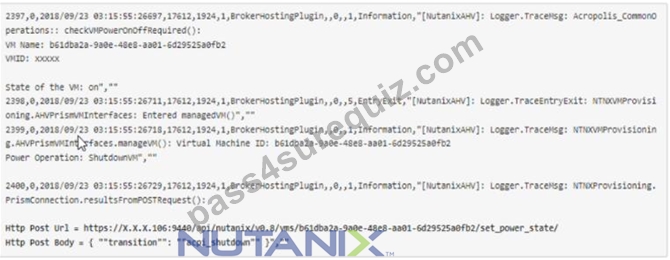
Following that while the VM is being powered OFF, query for the current VM state results in ON (the administrator sees a number of these until the VM is marked as power OFF) logs]: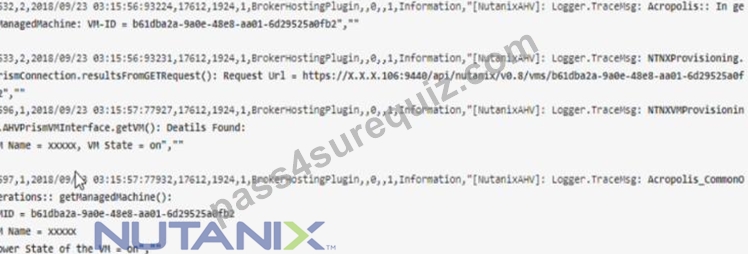
Upon further review the administrator notices in COF logs, after a number of queries for the machine state, one results in a conflicting state, reporting the Power state as ON anc OFF [CDF logs) HCM should the administrator resolve the issue?
- A. Delete Scheduled reboot settings
- B. Increase the distribution time in Machine Update Rollout
- C. Create a Scheduled reboot cycle.
- D. Decrease the distribution time in Machine Update Rollout
Answer: C
NEW QUESTION # 48
An administrator needs to configure a license server to be accessible by Frame desktops.
Which server should the administrator configure?
- A. Sandbox
- B. Azure VM Instance
- C. utility Server
- D. EC2 VM Instance
Answer: C
Explanation:
Frame is a cloud-based desktop-as-a-service platform that allows users to access Windows applications and desktops from any device1. A license server is a server that hosts a network licensing manager for software that requires licenses to run2. Frame supports using a utility server as a license server for Frame desktops1. A utility server is a stand-alone, general purpose Windows server that can be configured and managed from the Frame dashboard1.
https://docs.frame.nutanix.com/platform/admin/utility-servers/
NEW QUESTION # 49
Which solution can the administrator implement to resolve the issue?
- A. Downgrade the Nutanix AHV Plugin for Citrix to version 2.6 or below.
- B. Increase the number of snapshots to allow for the task to fetch a limited number of snapshots,
- C. Uninstall the Nutanix AHV Plugin for Citrix.
- D. Reduce the number of snapshots to allow for the task to fetch a limited number of snapshots.
Answer: D
Explanation:
This is because having too many snapshots can cause serialization or deserialization errors when using the JSON serializer5
https://next.nutanix.com/product-updates/ahv-plug-in-for-citrix-director-1-1-4-0-released-39682
NEW QUESTION # 50
Users are being prompted to restart their non-persistent desktops in the middle of the day.
which setting in the gold image would cause this to occur?
- A. The power profile turns the screen off after 10 minutes.
- B. Windows Update policy is set to Automatic.
- C. The mandatory Windows profile is set to v4,
- D. Java automatically checks for updates every' 24 hours.
Answer: B
Explanation:
non-persistent VDI machines are deleted when they are rebooted, logged off, or shut down. Therefore, Windows Update policy should be configured to prevent automatic updates that may trigger a restart on these machines1.
https://techcommunity.microsoft.com/t5/microsoft-defender-for-endpoint/onboarding-and-servicing-non-persistent-vdi-machines-with/ba-p/1360721
NEW QUESTION # 51
An administrator is deploying a new virtual desktop environment onto an existing Nutanix solution.
The virtual desktop environment will consist of these elements:
1000 instant clone call center virtual desktops (supporting 5 business units)
500 full clone developer virtual desktops (supporting 2 business units)
150 applications delivered via AppStacks (supporting 7 business units)
How many storage containers should be created to support these workloads?
- A. 0
- B. 1
- C. 2
- D. 3
Answer: C
Explanation:
Based on the given information, the administrator is deploying 1000 instant clone virtual desktops, 500 full clone virtual desktops, and 150 applications. To support these workloads, the Nutanix solution will need multiple storage containers.
According to the Nutanix Certified Professional - End User Computing (NCP-EUC) v6 guide, for VDI workloads, it is recommended to create a separate storage container for each type of desktop (e.g. instant clone, full clone) and another container for AppStacks. It is also recommended to have at least one container for metadata and one container for replicas.
Therefore, for this scenario, a total of 3 storage containers should be created:
One container for 1000 instant clone virtual desktops
One container for 500 full clone virtual desktops
One container for 150 applications delivered via AppStacks
So the answer is C. 3.
NEW QUESTION # 52
A group of developers are migrating from physical computers to persistent virtual desktops.
What is the recommended migration path?
- A. Convert the physical computers to virtual desktops,
- B. Deploy a base image and provision required hosted applications
- C. Deploy non-persistent desktops and install required applications.
- D. Convert the developers profile to a roaming profile.
Answer: A
Explanation:
persistent virtual desktops are virtual desktops that retain their state and configuration across sessions.
This means that users can customize their virtual desktops with their own applications, settings, and data, and have them available every time they log on.
Persistent virtual desktops are suitable for users who need a consistent and personalized experience, such as developers.
According to Nutanix best practices2, one of the recommended migration paths for persistent virtual desktops is to convert the physical computers to virtual desktops.
This can be done by using a tool such as VMware Converter or Microsoft Disk2vhd to create a virtual disk image of the physical computer's hard drive.
Then, this image can be imported into Nutanix Cloud Platform and used as a base image for creating persistent virtual desktops.
This migration path can preserve the existing applications, settings, and data of the physical computers and minimize the disruption for the users.
NEW QUESTION # 53
An administrator has finished deploying the Citrix backend infrastructure to Xi Leap and needs to expose the Citrix NetScaler VPX private VIP to the internet in order for users to be able to access the Citrix VDI desktops upon a DR failover.
What should the administrator perform in order for public internet access to be allowed to the Citrix NetScaler VPX?
- A. Executing /mps/deployment _ type.Py
- B. Floating IP Address
- C. FQDN registered in DNS.
- D. Disaster recovery node configured in HA mode.
Answer: B
Explanation:
Citrix NetScaler VPX is a virtual appliance that provides web and application load balancing, secure and remote access, acceleration, security and offload features1. To set up and configure a Citrix NetScaler VPX appliance, you need to download it from the Citrix website, install it on a hypervisor such as Citrix XenServer or Microsoft Azure23, and log on to the console using the nsroot credentials2.
To expose the Citrix NetScaler VPX private VIP to the internet in order for users to be able to access the Citrix VDI desktops upon a DR failover, one possible solution is to use a floating IP address. A floating IP address is an IP address that can be dynamically assigned to an instance by using API calls. It allows you to redirect network traffic from one instance to another without changing any DNS settings or client configuration.
NEW QUESTION # 54
An administrator has been asked by a user to configure a custom 4.2 MB background image for the assigned desktop instance. However. The administrator is receiving an error When attempting to assign this background image, Why is the administrator receiving this error?
- A. The minimum size for custom background image is 4 MB
- B. The minimum size for custom background image is 4.5 MB
- C. The minimum size for custom background image is 3 MB
- D. The minimum size for custom background image is 5 MB
Answer: B
NEW QUESTION # 55
Which metric is available in customized reports when using the AHV Plug-in for Citrix Director?
- A. VM Bandwidth latency
- B. VM Average I/O latency
- C. VM Network utilization
- D. VM CPU Ready time
Answer: C
Explanation:
Nutanix AHV Plug-In for Citrix Director provides more information on Citrix generated desktops running on Nutanix AHV. Some of the metrics that are available in customized reports are:
VM CPU Usage
VM Memory Usage
VM Disk IOPS
VM Disk Bandwidth
NEW QUESTION # 56
An administrator has been given a new support role for a group of 1000 users, which are all running Windows 10 Linked Clone virtual desktops, The administrator learns quickly that the environment has been undersized with constant complaints from the user community around running out of storage. The administrator further discovers that the environment is memory constrained.
Which feature should the administrator enable to help relieve the capacity issue?
- A. Erasure Coding
- B. Deduplication
- C. Auto-tiering
- D. Compression
Answer: B
Explanation:
Deduplication is a process that eliminates duplicate data blocks and reduces the amount of storage space required for virtual desktops. Deduplication can be enabled at both cluster level and container level on Nutanix.
Deduplication can also work with VCAI (View Composer Array Integration), which is a feature that uses Nutanix native NFS snapshot technology to clone VMs2. VCAI can improve performance and reduce storage consumption for linked-clone desktop pools.
Another feature that can help with capacity issue is Shadow Clones, which is a distributed caching mechanism that allows multiple VMs to read from a single vDisk copy stored locally on each node3. Shadow Clones can reduce network traffic and improve boot times for virtual desktops.
https://www.nutanix.com/support-services/training-certification/certifications/certification-details-nutanix-certified-professional-ncp-euc-v6
NEW QUESTION # 57
An administrator has been asked to enable mufti-monitor support for a graphic designer that needs to be able to use four monitors.
After on boarding the designer on to the Frame desktop, the end user does not see the ability to use all four monitors while using the Firefox web browser.
What should the administrator do to enable the ability to use all four monitors?
- A. Switch to Safari
- B. Switch to Chrome
- C. Deploy Frame App
- D. Switch to Edge
Answer: C
Explanation:
According to Nutanix documentation, to use more than two monitors with Frame, you need to deploy the Frame App. The Frame App provides multi-monitor support, whereas using Frame through web browsers is currently limited to two monitors.
Frame App is a native application that provides a better user experience for accessing Frame desktops and applications than a web browser1. Frame App supports the Frame multi-monitor feature automatically. If an end user has more than one monitor attached to their device, Frame App prompts the user if they want to use all of their monitors1. Frame Administrators do not have to enable explicitly multi-monitor support for Frame App users1.
NEW QUESTION # 58
Users are reporting that their desktops are running slower than expected in an ESXi-based Nutanix cluster. upon investigation, an administrator determines that desktops on one host are running slower and have higher CPU Ready times than on other hosts.
What is causing this issue?
- A. Inline Compression has been disabled on the desktop storage container
- B. Erasure coding's increased overhead has caused a slowdown in the environment
- C. High Performance host power policy is enabled
- D. High Performance host power policy is disabled
Answer: D
Explanation:
A high CPU Ready time means that the vCPU is waiting too long for the pCPU, which can result in poor performance and slow responsiveness of the virtual machine (VM).
According to Nutanix best practices2, one of the factors that can affect CPU Ready time is the host power policy. The host power policy determines how aggressively the host will try to save power by reducing the frequency or voltage of the pCPUs.
The recommended host power policy for Nutanix clusters is High Performance, which disables any power saving features and ensures that the pCPUs run at their maximum frequency and voltage.
This answer seems to explain why desktops on one host are running slower and have higher CPU Ready times than on other hosts, as they may be suffering from reduced pCPU performance due to a lower host power policy.
NEW QUESTION # 59
......
Download Free Nutanix NCP-EUC Real Exam Questions: https://certkingdom.pass4surequiz.com/NCP-EUC-exam-quiz.html