

[Feb-2022] Verified Oracle Exam Dumps with 1z0-1072-21 Exam Study Guide
Best Quality Oracle 1z0-1072-21 Exam Questions Pass4SureQuiz Realistic Practice Exams [2022]
NEW QUESTION 29
You have an application server running in a public subnet on a compute instance in US West (us-phoenix-1) region of Oracle Cloud Infrastructure (OCI).The data sitting on this instance needs to be copied to OCI Object storage bucket available in the same region without traversing over the internet. To enable the connectivity between the instance and Object Storage, you created a service gateway with service CIDR of all Object Storage in us-phoenix-1 enabled. You also modified the security rules to allow the desired traffic.
However, when you tried sending the data to the Object Storage bucket, you notice that the data is going over the internet and not via the service gateway.
What could be the possible reason for this behavior?
- A. The security list associated with the subnet has an egress rule that allows all traffic to be forwarded to a destination CIDR 0.0.0.0/0
- B. The route table associated with the subnet has no route rule where the destination is object storage service
- C. The service gateway created in the VCN resides in a differentavailability domain
- D. Identity and Access Management (IAM) policies restrict the access to the object storage bucket
Answer: B
NEW QUESTION 30
Which two Oracle CloudInfrastructure database services allow you to dynamically both scale CPU and storage? (Choose two.)
- A. virtual machine DB system
- B. Autonomous Transaction Processing (ATP)
- C. bare metal DB system
- D. Autonomous Data Warehouse (ADW)
Answer: B,D
Explanation:
Explanation
If a bare metal DB system requires more compute node processing power, you can scale up (increase) the number of enabled CPU cores in the system without impacting the availability of that system but you can't increase the storage If the original DB system VM shapeuses a single node, running databases on the DB system nodes are sequentially stopped and then restarted on the new shape so not dynamic
NEW QUESTION 31
You deployed a web server in Oracle Cloud Infrastructure using an ephemeral public IP. After a few changes in your web server configuration, you rebooted the server and a new public IP was associated to your instance.
What should you doto prevent this from happening again?
- A. Create a reserved public IP and associate it with the hosts file of your web server
- B. Create a reserved public IP and associate it with the security list that your complete instance is using
- C. Create a reserved public IP and associate it with the subnet of your compute instance
- D. Create a reservedpublic IP and associate it with the VNIC of your compute instance
Answer: D
Explanation:
Explanation
A public IP address is an IPv4 address that is reachable from the internet. If a resourcein your tenancy needs to be directly reachable from the internet, it must have a public IP address. Depending on the type of resource, there might be other requirements.
There are two types of public IPs:
Ephemeral: Think of it as temporary and existingfor the lifetime of the instance.
Reserved: Think of it as persistent and existing beyond the lifetime of the instance it's assigned to. You can unassign it and then reassign it to another instance whenever you like. Exception: reserved public IPs on public load balancers.
To create a new reservedpublic IP in your pool
Confirm you're viewing the region and compartment where you want to create the reserved public IP.
Open the navigation menu. Under Core Infrastructure, go to Networking and click Public IPs.
Click Create Reserved Public IP.
Enter the following:
Name: An optional friendly name for the reserved public IP. The name doesn't have to be unique, and you can change it later. Avoid entering confidential information.
Compartment: Leave as is.
Tags:Optionally, you can apply tags. If you have permissionsto create a resource, you also have permissions to apply free-form tags to that resource. To apply a defined tag, you must have permissions to use the tag namespace. For more information about tagging, see Resource Tags. If you are not sure if you should apply tags, skip this option (you can apply tags later) or ask your administrator.
Click Create Reserved Public IP.
To assign a reserved public IP to a private IP
Prerequisite: The private IP must not have an ephemeral or reserved public IP already assigned to it. If it does, first delete the ephemeral public IP, or unassign the reserved public IP.
Confirm you're viewing the compartment that contains the instance with the private IP you're interested in.
Open the navigation menu. Under Core Infrastructure, go to Compute and click Instances.
Click the instance to view its details.
Under Resources, click Attached VNICs.
The primary VNIC and any secondary VNICs attached to the instance are displayed.
Click the VNIC you're interested in.
Under Resources, click IP Addresses.
The VNIC's primary private IP and any secondary private IPs are displayed.
For the private IP you're interested in, click the Actions icon (three dots), and then click Edit.
In the Public IP Address section, for Public IP Type, select the radio button for Reserved Public IP.
Enter the following:
Compartment: The compartment that contains the reserved public IP you want to assign.
Reserved Public IP: The reserved public IP you want to assign. You have three choices:
Create a new reserved public IP. You may optionally provide a friendly name for it. The name doesn't have to be unique, and you can change it later. Avoid entering confidential information.
Assign a reserved public IP that is currently unassigned.
Move a reserved publicIP from another private IP.
Click Update.
NEW QUESTION 32
Your IT department wants to cut down storage costs, but also meet compliance requirements as set up by the central audit group. You have a legacy bucket with both Word does (*.docx) and Excel files (*.xlsx). Your auditors want to retain only Excel files for compliance purposes. Your IT departments wants to keep all other files for 365 days only. What two steps can you take to meet this requirement?
- A. Create Object Storage Lifecycle rules to delete objects from the legacy bucket after 365 days with a filter type - include by pattern: ''.docx
- B. Create Object Storage Lifecycle rules to delete objects from the legacy bucketafter 365 days without any pattern matching
- C. Create Object Storage Lifecycle rules toarchive objects from the legacy bucket after 365 days without any pattern matching
- D. Create Object Storage Lifecycle rules to delete objects from the legacy bucket after 365 days with a filter type - exclude by pattern: ''.xlsx"
- E. It is not possible tomeet this requirement
Answer: A,D
Explanation:
Explanation
Object Lifecycle Management lets you automatically manage the archiving and deletion of objects. By using Object Lifecycle Management to manage your Object Storage and Archive Storage data, you can reduce your storage costs and the amount of time you spend managing data.
Use object name filters to specify which objects the lifecycle rule applies to.
You can add object filters in any order. Object Lifecycle Management evaluates the precedence of the rules as follows:
Pattern exclusions
Pattern inclusions
Prefix inclusions
NEW QUESTION 33
Which ofthe following statements is true about the Oracle Cloud Infrastructure (OCI) Object Storage serverside encryption?
- A. Encryption of data encryption keys with a master encryption key is optional.
- B. Each object in a bucket is always encrypted with the same data encryption key.
- C. Encryption is enabled by default and cannot be turned off.
- D. Customer-provided encryption keys are always stored inOCI Vault service.
Answer: D
Explanation:
Reference:https://docs.cloud.oracle.com/en-us/iaas/Content/Object/Tasks/usingyourencryptionkeys.htm
NEW QUESTION 34
You have deployed a compute instance (VM.Standard2.24) to run an Oracle database. With this set up, you run into some performance issues and want to leverage an OCI Dense IO shape (VM.DenseIO2.24), with which you get 25.6 TB local NVMe SSD. You do not want to lose the configuration changes you made to the instance. Which of the following TWO steps ARE NOT required to make this transition?
- A. Terminate the VM.Standard2.24 instance and preserve the boot volume
- B. Create a new instance using a VM.DenseIO2.24 shape using the preserved boot volume and move the Oracle Database data to block volumes
- C. Create a new instance using the VM.Dense102.24 shape using the preserved boot volume and move the Oracle Database data to NVMe disks
- D. Terminate the VM.Standard2.24 instance and do not preserve the boot volume
Answer: B,D
Explanation:
Explanation
You can permanently terminate (delete) instances that you no longerneed. Any attached VNICs and volumes are automatically detached when the instance terminates. Eventually, the instance's public and private IP addresses are released and become available for other instances. By default, the instance's boot volume is deleted when you terminate the instance, however you can preserve the boot volume associated with the instance, so that you can attach it to a different instance as a data volume, or use it to launch a new instance.
Dense I/O Shapes Designed for largedatabases, big data workloads, and applications that require high-performance local storage. DenseIO shapes include locally-attached NVMe-based SSDs.
so once you create the VM.DenseIO you need to moce the Database to locally-attached NVMe-based SSDs
NEW QUESTION 35
Your Operations team has recently created a new, standard image that will be used to launch all new application servers in the Finance compartment. The custom image currently exists inthe Operations compartment. You have access to manage all-resources in the Finance compartment and do not have access to the Operations compartment.
Which two methods would make the new image available for you to use when deploying new servers in the Finance compartment? (Choose two.)
- A. Instruct the Administrators team to grant you accessto use instance-images in the Operations compartment. Use the Oracle Cloud Identifier (OCID) of the custom image when launching new compute resources in the Finance compartment.
- B. Instruct the Operations team to export the image to an object storage bucket, create a PAR, and provide you with the URL. Use that URL as the source when importing a custom image. Import the custom image into the Finance compartment.
- C. Instruct the Operations team to export the image to an object storage bucket. Instruct the Administrators team to grant you access to the object storage bucket where the custom image is stored. Use the download URL of the custom image as the image source when launching new compute resources in the Finance compartment.
- D. Instruct the Operations team to export the image toan object storage bucket, create a pre-authenticated request (PAR), and provide you with the URL. Download the custom image to your laptop and import it as a custom image in the Finance compartment.
- E. Instruct the Operations team to reassign the custom image to the Finance compartment so you can select it from a drop-down list when launching new compute resources.
Answer: A,C
NEW QUESTION 36
Which two statements are true about data guard service on DB Systems in Oracle Cloud Infrastructure (OCI)?
(Choose two.)
- A. Data guard configuration on the OCI is limited to a virtual machine only
- B. Data guard configuration on the OCI is limited to one standby database per primary database
- C. Data guard implementation requires two DB Systems, one containing the primary database and one containing the standby database
- D. Data guard implementation requires two DB Systems, one running the primary database on a virtual machine and the standby database running on bare metal
Answer: B,C
NEW QUESTION 37
Where is the tenancy Oracle Cloud Identifier (OCID) located?
- A. given by support on account creation
- B. contained within the compartment OCID
- C. at the bottom of every console page
- D. on the Identity - Users page
Answer: B
Explanation:
Explanation
Identity > Compartments >(The root Compartment of the tenancy)
NEW QUESTION 38
You have provisioned an Autonomous Transaction Processing (ATP) database and logged into the ATP service console.
What are three abilities that can be performed from this service console? (Choose three.)
- A. set resource management rules
- B. create ATP database users
- C. reset the admin password
- D. scale up/down the CPUs
- E. monitor database activity and SQL queries
Answer: A,C,E
Explanation:
Explanation
In ATP Service Console,
In the activity screen allows you to perform some basic monitor database activity and SQL queries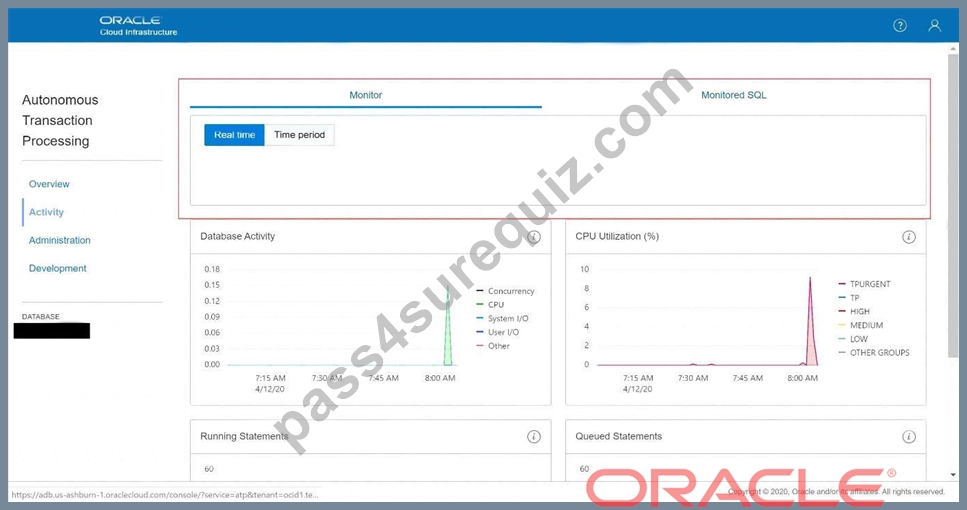
In the administration screen allows you toperform some basic administration of the service, like reset the admin password and set resource management rules
NEW QUESTION 39
Which two options are true for Autonomous Transaction Processing (ATP) database? (Choose two.)
- A. You can scale storage up or down in ATP
- B. You can add new ORACLE_HOME for bringing older versions of on-premises databases to ATP
- C. You can add/remove Diskgroup in ATP
- D. You canadd more Pluggable Database for consolidating multiple databases in ATP
- E. You can scale CPU up or down in ATP
Answer: A,E
Explanation:
Explanation
You can scale up/down your Autonomous Database to scale both in terms ofcompute and storage only when needed, allows people to pay per use.
Oracle allows you to scale compute and storage independently, no need to do it together. these scaling activities fully online (no downtime required) in Details page Autonomous Database click Scale Up/Down. Click on arrow to select a value for CPU Core Count or Storage (TB).
Or Select auto scaling to allow the system to automatically use up to three times more CPU and IO resources to meet workload demand, compared to the database operatingwith auto scaling disabled.
NEW QUESTION 40
You have a working application in the US East region. The app is a 3-tier app with a database backend - you take regular backups of the database into OCI Object Storage in the US East region. For Business continuity; you are leveraging OCI Object Storage cross-region copy feature to copy database backups to the US West region. Which of the following three steps do you need to execute to meet your requirement?
- A. Provide a destination object name
- B. Specify an existing destination bucket
- C. Provide an option to choose bulkcopying of objects
- D. Write an IAM policy and authorize the Object Storage service to manage objects on your behalf
- E. Choose an overwrite rule
- F. Specify the bucket visibility for both the source and destination buckets
Answer: B,D,E
Explanation:
Explanation
You can copy objects to other buckets in the same region and to buckets in other regions.
You must have the required access to both the source and destination buckets when performing an objectcopy.
You must also have permissions to manage objects in the source and destination buckets.
Because Object Storage is a regional service, you must authorize the Object Storage service for each region carrying out copy operations on your behalf. For example, you might authorize the Object Storage service in region US East (Ashburn) to manage objects on your behalf. Once you authorize the Object Storage service, you can copy an object stored in a US East (Ashburn) bucket to a bucket in another region.
You can use overwrite rules to control the copying of objects based on their entity tag (ETag) values.
Specify an existing target bucket for the copy request. The copy operation does not automatically create buckets.
NEW QUESTION 41
Which two statements are true about Oracle Cloud Infrastructure storage services?
- A. You can take Incremental snapshots of BlockVolumes, File Storage file systems and Object Storage buckets.
- B. You can move Object Storage buckets, Block Volumes and File Storage mount targets between compartments.
- C. File storage mount target does not provide a private IP address, while the Object Storage bucket provides one.
- D. File Storage uses the network file system (NFS) protocol, whereas Block Volume uses ISCSI.
- E. Block Volume service scales to Exabytes per Instance, while File Storage service offers unlimited scalability.
Answer: B,D
NEW QUESTION 42
You are running several Linux based operating systems in your on .premises environment that you want to import to OCI as custom images. You can launch your imported images as OCI compute Virtual machines.
Which two modes below can be usedto launch these imported Linux VMs?
- A. Emulated
- B. Paravirtualized
- C. Native
- D. Mixed
Answer: A,B
Explanation:
Explanation
You can use the Console or API to import exported images from Object Storage. To import an image, you need read access to the Object Storage object containing the image.
during the Import you can select the Launch mode:
For custom images where the image format is .oci, Oracle Cloud Infrastructure selects the applicable launch mode based on the launch mode for the source image.
For custom images exported from Oracle Cloud Infrastructure where the image type is QCOW2, select Native Mode.
To import other custom images select Paravirtualized Mode or Emulated Mode. For more information, see Bring Your Own Image (BYOI).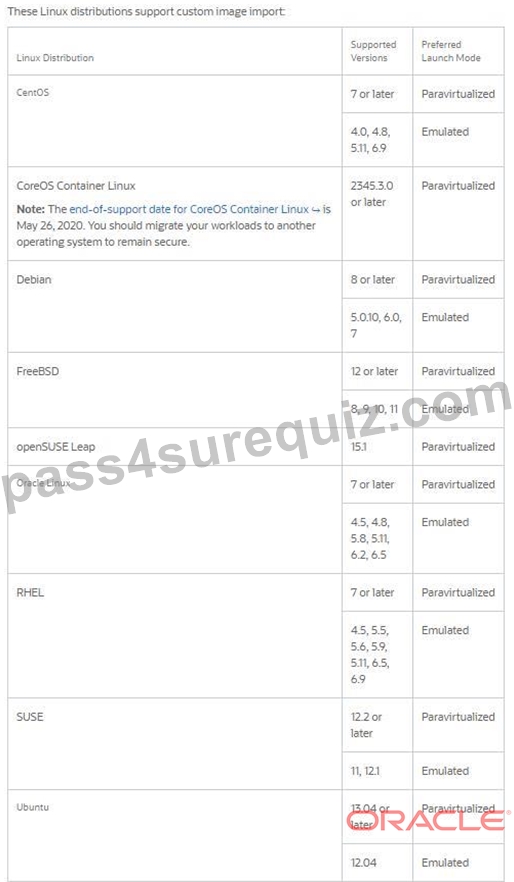
NEW QUESTION 43
Whichstatement is NOT true about the Oracle Cloud Infrastructure Object Storage service?
- A. Object storage resources can be shared across tenancies.
- B. Immutable option for data stored in the Object Storage can be set via retention rules.
- C. Object lifecycle rules can be used to either archive or delete objects.
- D. Object versioningis enabled at namespace level.
Answer: B
Explanation:
Reference:https://docs.cloud.oracle.com/en-us/iaas/Content/Object/Tasks/usingversioning.htm
NEW QUESTION 44
You have hired a new employee to run reports from the Autonomous Data Warehouse (ADW) and are not confident in their SQL writing ability.
Into which consumer group will you assign this individual to minimize the impact of their code?
- A. Medium
- B. High
- C. Lowest
- D. Low
- E. Highest
Answer: D
Explanation:
Explanation
in ADW, The tnsnames.ora file provided with the credentials zip file contains three database service names identifiable as high, medium, and low. The predefined service names provide differentlevels of performance and concurrency for Autonomous Data Warehouse.
high: The High database service provides the highest level of resources to each SQL statement resulting in the highest performance, but supports the fewest number of concurrent SQL statements. Any SQL statement in this service can use all the CPU and IO resources in your database. The number of concurrent SQL statements that can be run in this service is 3, this number is independent of the number of OCPUs in your database.
medium: The Medium database service provides a lower level of resources to each SQL statement potentially resulting a lower level of performance, but supports more concurrent SQL statements. Any SQL statement in this service can use multiple CPU and IO resources in yourdatabase. The number of concurrent SQL statements that can be run in this service depends on the number of OCPUs in your database.
low: The Low database service provides the least level of resources to each SQL statement, but supports the most number of concurrent SQL statements. Any SQL statement in this service can use a single CPU and multiple IO resources in your database. The number of concurrent SQL statements that can be run in this service can be up to 300 times the number of OCPUs.
The predefinedservice names provide different levels of performance and concurrency for Autonomous DB Choose whichever database service offers the best balance of performance and concurrency.
Use the low database service name. to minimize the impact of their SQLs to by low consumer group
NEW QUESTION 45
You have the following compartment structure in your tenancy. Rootcompartment->Training->Training-subl
->Training-sub2 You create a policy in the root compartment to allow the default admin for the account (Administrators) to manage block volumes in compartment Training-sub2. What policy would you write to meet this requirement?
- A. Allow group Administrators to manage volume-family in root compartment
- B. Allow group Administrators to manage volume-family in compartment Training-sub2
- C. Allow group Administrators to manage volume-family in compartmentTraining: Training-sub 1
:Training-sub2 - D. Allow group Administrators to manage volume-family in compartment Training-sub1 :Training-sub2
Answer: C
Explanation:
Explanation
a policy statement must specify the compartment for which access is being granted (or the tenancy). Where you create the policy determines who can update the policy. If you attach the policy to the compartment or its parent, you can simply specify the compartment name. If you attach the policy further up the hierarchy, you must specify the path. The format of the path iseach compartment name (or OCID) in the path, separated by a colon:
<compartment_level_1>:<compartment_level_2>: . . . <compartment_level_n> For example, assume you have a three-level compartment hierarchy, shown here:
You want to create a policy to allowNetworkAdmins to manage VCNs in CompartmentC. If you want to attach this policy to CompartmentC or to its parent, CompartmentB, write this policy statement:
Allow group NewtworkAdmins to manage virtual-network-family in compartment CompartmentC However, if you want to attach this policy to CompartmentA (so that only administrators of CompartmentA can modify it), write this policy statement that specifies the path:
Allow group NewtworkAdmins to manage virtual-network-family in
compartmentCompartmentB:CompartmentC
To attach this policy to the tenancy, write this policy statement that specifies the path from CompartmentA to CompartmentC:
Allow group NewtworkAdmins to manage virtual-network-family in compartment CompartmentA:CompartmentB:CompartmentC
NEW QUESTION 46
......
Authentic Best resources for 1z0-1072-21: https://certkingdom.pass4surequiz.com/1z0-1072-21-exam-quiz.html